
Kyle Schwarber’s Home Run Hitting Tour Turned Phillies Power Into a Road Show
Schwarber’s 2026 season has made every at-bat feel like a possible event. With Philadelphia hosting All-Star Week and Schwarber still driving the league’s home run conversation, the Home Run Hitting Tour design reads like a black-shirt concert poster for baseball damage.
By early July, Kyle Schwarber’s season had become impossible to discuss quietly. The Phillies slugger was not merely adding home runs to a stat line; he was giving Philadelphia a recurring sound — the hard contact, the instant camera lift, the right-field crowd reaction, the sense that one swing could reset an entire night.
The timing made the noise louder. Philadelphia was moving toward the 2026 MLB All-Star Game at Citizens Bank Park, the Phillies had multiple All-Star names in the national conversation, and Schwarber’s left-handed power remained one of the most recognizable forces in the sport. When a hitter is sitting near the top of the league’s home run board in the same summer his city hosts baseball’s showcase, the whole thing starts to feel theatrical.
That is the space where the Home Run Hitting Tour idea makes sense. Schwarber’s homers do not feel like isolated highlights. They feel like stops on an itinerary: another city, another pitcher, another ball leaving the frame, another fan base forced to watch Philadelphia’s designated thunder arrive with luggage.
Schwarber at the plate has become a touring act: same violent swing, new city, fresh souvenir for the highlight reel.
Why Schwarber’s Power Feels Like an Event
Some power hitters are admired for clean mechanics. Schwarber is experienced differently. His best swings have a weather-system quality: the lower half loads, the barrel arrives, and the ball seems to leave with the force of something scheduled rather than accidental. Phillies fans know the feeling before the broadcast graphic catches up.
That matters because Philadelphia does not merely consume baseball through numbers. The city attaches mood to players. Bryce Harper carries drama and command. Brandon Marsh brings dirt, movement and fan-favorite energy. Zack Wheeler brings ace-level seriousness. Schwarber brings impact. He is the hitter who can make a game feel stuck for six innings, then suddenly make it feel rewritten.
In 2026, that identity became even more visible as Schwarber’s home run pace stayed central to Phillies coverage. Every big swing added to the idea that his season was not just about production, but about recurring spectacle — the kind of spectacle that belongs naturally in poster language.
The Artwork Understands the Joke and the Myth
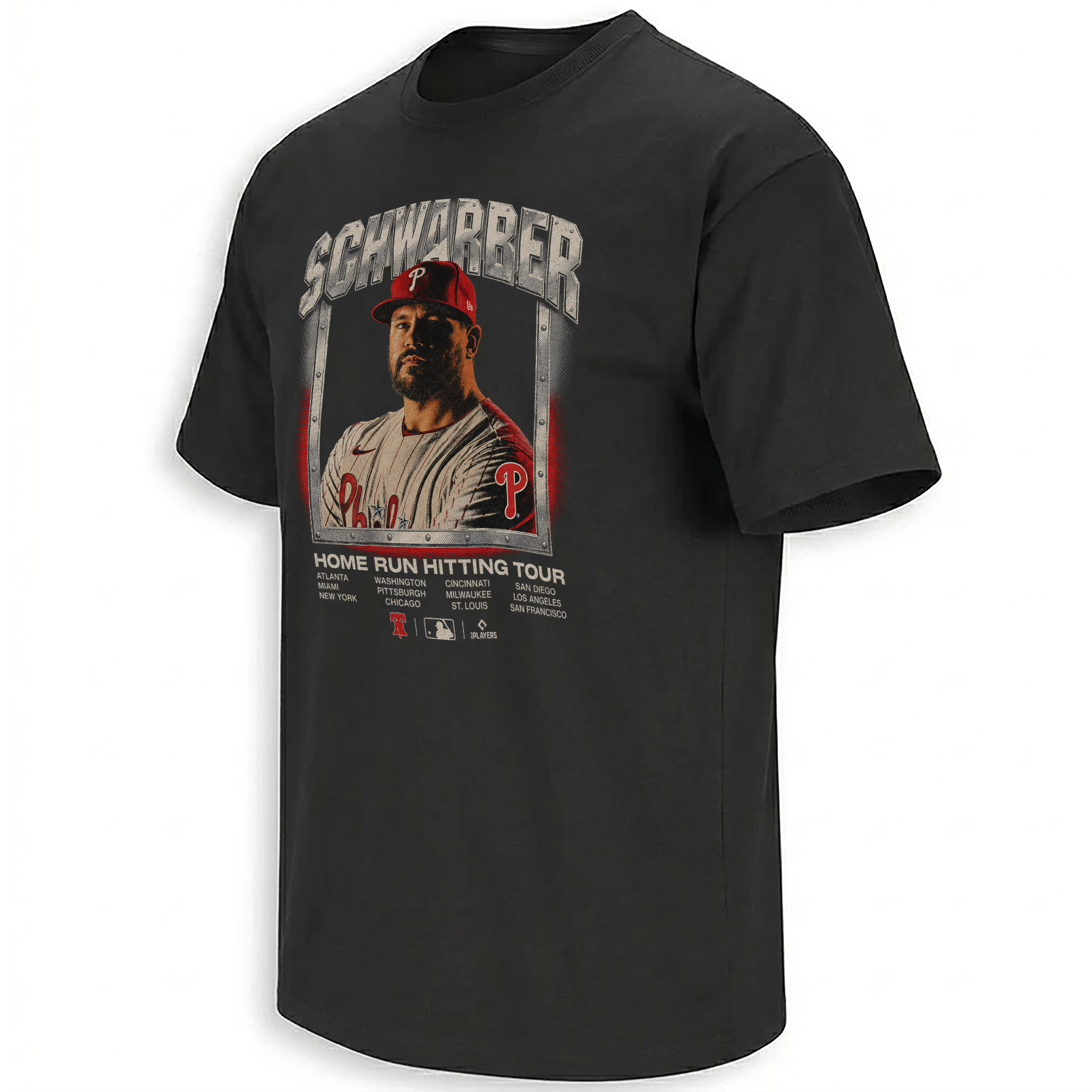
The phrase “Home Run Hitting Tour” works because it sits between comedy and truth. It is funny because a baseball player is being framed like a rock act. It is convincing because Schwarber’s home runs already travel that way in fan memory. Atlanta, Miami, New York, Washington, Pittsburgh, Chicago, Cincinnati, Milwaukee, San Diego, Los Angeles and San Francisco read less like a schedule and more like a damage map.
The graphic uses a black shirt base to create a stadium-night atmosphere. The large arched “SCHWARBER” headline feels like an arena sign, not a quiet player label. The portrait is locked inside a riveted metal-style frame, which gives the image weight and makes Schwarber look like the centerpiece of a touring poster rather than a standard lineup cutout.
Red glow behind the figure does important emotional work. It connects the graphic to Phillies color, but it also creates a stage-light effect. The design is not saying Schwarber plays baseball softly. It is saying his power arrives with lighting, volume and smoke.
The arched metallic type, red glow, black base, framed portrait and city-list typography push the shirt toward concert-poster territory. The result feels like a baseball flyer for a slugger whose home runs follow him from park to park.
A Tour Poster Is the Right Format for Schwarber
Most baseball graphics choose one of two routes: action shot or milestone text. This one chooses a different language. It treats Schwarber’s power as an act that travels. That choice fits him because his home runs often become portable memories — clips fans replay, stats people screenshot, and road-game moments that make Phillies fans feel present even when the team is away from South Philadelphia.
The city list is the design’s best storytelling detail. It turns the lower half of the artwork into something like tour dates on the back of an old black tee. In music culture, that list says the show happened across a map. In baseball culture, it suggests the same thing: Schwarber’s swing does not belong to one ballpark. It follows the schedule.
That format also avoids making the piece depend on one exact game. A single home run can be dramatic, but the Tour concept is broader. It captures the larger identity of a hitter whose presence changes the way fans watch every inning.
Philadelphia’s All-Star Summer Made the Power Feel Bigger
The All-Star Game changes the scale of a baseball city for a few days. Local stories become national backdrops. Ballpark images turn into league branding. Player selections become part of a larger civic atmosphere. In 2026, that mattered for Philadelphia because the Phillies were not watching the Midsummer Classic from a distance. The event was coming home.
Schwarber’s selection as a National League All-Star reserve added another layer to that stage. He did not need an All-Star logo to be understood as a power figure, but the selection placed his season inside the league’s official summer conversation. It made the Tour idea feel less like exaggeration and more like recognition.
At the same time, the wider Phillies All-Star group helped turn the week into a franchise snapshot. Brandon Marsh’s first career selection, Harper’s star presence, Cristopher Sánchez’s pitching rise and Jhoan Duran’s late-inning profile all gave Philadelphia different storylines. Schwarber’s role was the loudest one visually: the hitter whose swing could turn an ordinary count into a headline.
Atlanta, Miami, New York, Washington, Pittsburgh, Chicago, Cincinnati, Milwaukee, San Diego, Los Angeles and San Francisco are not presented as random decoration. They give the graphic its tour logic — a map of places where Schwarber’s power can become the night’s defining image.
From Schwarbombs to Road-Show Language
Phillies fans already had a word for the shape of a Schwarber swing: Schwarbomb. That kind of fan language matters because it shows how a player has moved beyond ordinary description. A home run becomes a phrase. A phrase becomes a shorthand. A shorthand becomes part of how the fan base experiences the season.
The Home Run Hitting Tour design extends that vocabulary. Instead of only celebrating one ball leaving one park, it imagines Schwarber’s power as a recurring act. The joke is not that he literally tours like a musician. The joke is that, emotionally, fans already track his power that way — city by city, series by series, blast by blast.
That is why the artwork belongs in the same ecosystem as other Phillies culture graphics in the Philadelphia Phillies collection. The strongest team designs do not only name the roster. They preserve the little languages fans build around players. Schwarbombs, Red October, Marsh chaos, Harper drama and Wheeler dominance all become part of one running visual archive.
The MLB Frame: Power Still Cuts Through Everything
Modern baseball is full of layered analysis: chase rate, expected slugging, launch angle, bat speed, matchups and bullpen leverage. Those numbers explain the sport, but they do not replace the oldest thrill in the game. A home run still ends the argument in one swing.
Schwarber’s appeal sits exactly there. His profile can be debated analytically, but the fan reaction is immediate. When he connects, the conversation does not need much translation. The ball travels, the scoreboard changes, and the crowd understands the story at once.
That makes the shirt fit naturally inside the broader MLB Shirts collection, where baseball moments are collected not only by team, but by the ways fans remember them: walk-off chaos, ace performances, rivalry jokes, postseason slogans and power swings that feel loud before they even land.
How a Schwarber Graphic Becomes a Timestamp
The reason this design works beyond one box score is that it records a baseball identity rather than a single statistic. The current number matters because it proves the moment is alive, but the visual meaning is bigger: Schwarber as a traveling power act, Philadelphia as the stage, and 2026 as the summer when the theme became easy to read.
In that sense, the black tee base is not just a color choice. It turns the whole piece into a night-game object. The metal frame, red glow and tour-date city list all make the design feel pulled from a merch table outside a loud venue after the show. Except here, the show is a baseball season, and the encore is another ball sent into the seats.
Fans often keep sports graphics because they help them remember how a player felt during a specific window of time. This one remembers Schwarber as impact, volume and travel — the home run hitter as a road-show headline.
Frequently Asked Questions
Why does the Schwarber Home Run Hitting Tour design feel current?
It connects directly to Kyle Schwarber’s 2026 power surge, his All-Star season in Philadelphia and the way his home runs have remained central to the Phillies conversation.
What does “Home Run Hitting Tour” mean?
The phrase turns Schwarber’s home run reputation into a road-show concept, with different MLB cities presented like tour stops for his left-handed power.
Why is the city list important in the artwork?
The city list gives the graphic its concert-poster structure and suggests that Schwarber’s power travels with the Phillies from ballpark to ballpark.
How does the design connect to Phillies culture?
The red accents, Phillies-style portrait, black stadium-night base and Schwarber power theme all connect the graphic to Philadelphia baseball’s love of loud swings and player-driven fan language.
Why does Schwarber’s power translate well into poster art?
Schwarber’s home runs already feel theatrical to fans, so a tour-poster layout gives visual shape to the idea of a slugger whose biggest swings become events across the schedule.
The Schwarber Home Run Hitting Tour graphic captures the left-handed power, black-shirt poster mood and city-by-city mythology of his 2026 season, while the wider Philadelphia Phillies archive follows the player moments and fan language shaping this era of baseball in South Philly.
Schwarber Shirt turns Kyle Schwarber’s Phillies power-hitter identity into a black tour-poster baseball graphic, using metallic lettering, red stadium energy and a city-list layout to capture his 2026 Home Run Hitting Tour.