Kevin McGonigle’s Claw-Mark Summer Is Turning Detroit’s Future Into the Present
By the beginning of July, Kevin McGonigle had already moved beyond the normal boundaries of a rookie introduction. His disciplined left-handed bat, aggressive baserunning, improving defense and long-term Tigers contract have made No. 7 one of Detroit baseball’s defining images of 2026.
Kevin McGonigle entered July with more than a promising stat line. He carried the unusual authority of a rookie whose organization had already removed most of the uncertainty surrounding his future.
Detroit placed him on the Opening Day roster at 21 years old, watched him reach base at a rate near .400 through the first half and trusted him enough to sign an eight-year extension worth $150 million. The deal runs through 2034, transforming his rookie season from a temporary audition into the opening chapter of a planned era.
On the field, McGonigle supplied the evidence that made the commitment understandable. He combined a batting average around .280 with exceptional strike-zone control, double-digit stolen bases and a collection of defensive moments that expanded his identity beyond the highly rated bat that carried him through the Minor Leagues.
The claw marks no longer represent a prospect trying to break into Detroit’s future. They represent a rookie who has already torn open a permanent place in the present.
The Rookie of the Year Case Is Built on More Than Power
McGonigle’s first half did not depend on an unsustainable home-run barrage. His strongest offensive skill remained the one scouts had identified long before his Major League debut: control of the strike zone.
That approach allowed him to reach base even during stretches when the home-run swing was quiet. He worked counts, accepted walks and forced pitchers to enter the zone rather than expanding it for them.
The resulting profile looked unusually complete for a 21-year-old. McGonigle could begin an inning by reaching base, advance through speed and later change another game with extra-base contact. That versatility helped move him into the American League Rookie of the Year conversation by midseason.
The Seattle Game Became His First Complete Detroit Scene
On June 7 at Comerica Park, McGonigle supplied two different versions of a decisive hit. His fourth home run of the season tied Seattle in the fourth inning. In the ninth, facing one of baseball’s strongest late-inning relievers, he lined a two-run single to right field and delivered a 5–4 walk-off victory.
The two swings explained his value better than one isolated statistic. The home run showed that his compact left-handed mechanics could produce damage. The walk-off showed that he did not need to chase another home run when the game required controlled contact.
That afternoon also altered his relationship with the crowd. McGonigle was no longer simply Detroit’s celebrated young player. He had supplied a shared Comerica Park memory with a beginning, comeback and final swing.
Why the Claw-Mark Artwork Fits the New Moment
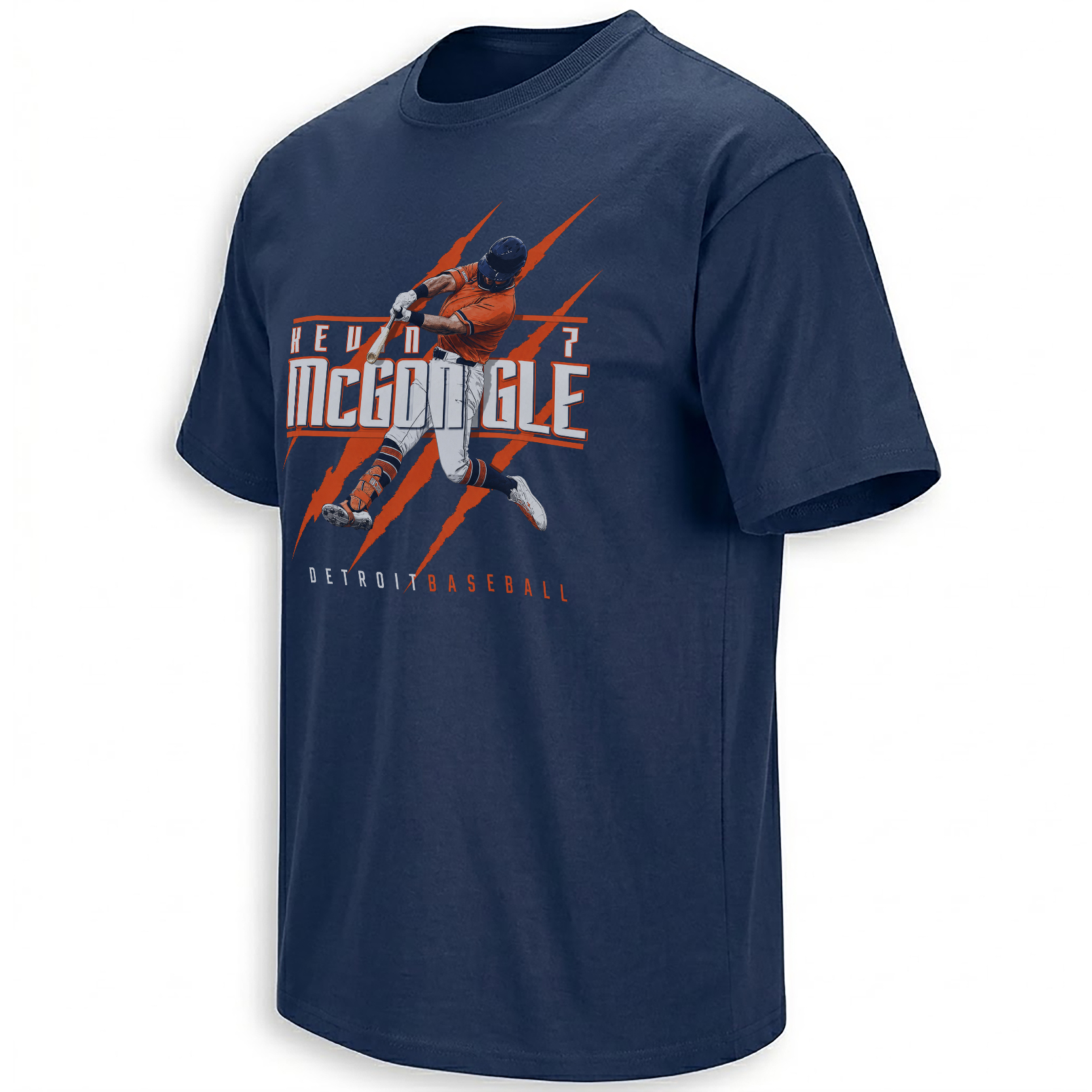
The design catches McGonigle during the finish of his left-handed swing. His body rotates through the center of the composition while three diagonal claw marks slice across the background.
Those marks perform two jobs. They connect the graphic immediately to the Tigers, but they also describe the speed of his arrival. McGonigle is not contained inside a neat rookie-card frame. His swing appears to rip through it.
Detroit navy provides the historical foundation, while orange functions as the disruptive color. It enters through the claw marks, highlighted edges and name treatment, creating the sensation that a younger visual identity is breaking through an older baseball surface.
A Compact Swing Produces a Large Visual Effect
McGonigle does not create power through an exaggerated uppercut or a dramatic pre-pitch movement. His swing is relatively direct, built around quick hands, controlled rotation and a barrel that remains in the hitting zone long enough to support contact across different pitch locations.
That compactness creates an interesting contrast inside the artwork. The physical motion is efficient, but the claw marks and oversized typography make the cultural effect feel expansive.
Quick hands, a direct left-handed path and strong strike-zone decisions allow McGonigle to produce contact without sacrificing control.
Torn diagonal marks, layered navy shadows and orange impact lines enlarge the swing into a Motor City rookie-arrival poster.
Speed Changed the Shape of His Offensive Identity
Prospect discussions often concentrated on McGonigle’s bat-to-ball ability. His first Major League summer revealed another source of pressure: baserunning.
Eleven stolen bases by the beginning of July gave Detroit an additional way to benefit from his on-base skill. A walk could become a runner in scoring position. A single could force the defense to change its attention before the next pitch.
That speed also strengthened the larger rookie narrative. McGonigle was not waiting for extra-base hits to create value. He could alter an inning through decisions made after reaching first base.
The Long-Term Deal Changed Every Image Around Him
Detroit’s eight-year commitment changed the meaning of each current McGonigle highlight. A rookie home run normally belongs to an uncertain timeline. After the extension, the same clip began to look like the first entry in a much longer city archive.
The contract did not guarantee awards, health or uninterrupted development. It did reveal how strongly the Tigers believed in the underlying approach: advanced plate discipline, contact ability, athleticism and enough defensive flexibility to remain central even as the surrounding roster changes.
The agreement extending through 2034 turned McGonigle from a temporary rookie sensation into a declared foundation piece. The claw-mark design now reads as the first poster of an era Detroit expects to continue.
Defense Expanded the Rookie Highlight Reel
McGonigle’s early defensive work gave Detroit fans a second visual vocabulary. His leaping play and throw against Minnesota on June 10 showed that his athleticism could become visible even during games when the bat was not producing the main headline.
Those moments matter because young hitters are frequently reduced to offensive projections. A difficult play at third base or shortstop allows the audience to see anticipation, balance and arm strength rather than simply reading about them in a scouting report.
The result is a more complete cultural character: No. 7 at the plate, on the bases and cutting across the infield.
Detroit’s Future No Longer Feels Distant
Rebuilding teams often speak about the future as an abstract destination. Prospects remain in the Minors, contract plans remain theoretical and fans are asked to imagine what the roster may eventually become.
McGonigle shortened that distance. He arrived, produced immediately and received a contract designed to carry him through his prime. The future did not replace the present; it entered the lineup beside it.
The Detroit Tigers collection follows that changing Motor City identity through current players, rookie imagery and navy-and-orange visual language.
Inside the broader MLB Shirts collection, the McGonigle graphic belongs to baseball’s recurring tradition of documenting the precise season when a prospect becomes part of a city’s permanent imagination.
Frequently Asked Questions
Who is Kevin McGonigle?
Kevin McGonigle is a left-handed-hitting Detroit Tigers infielder drafted 37th overall in 2023. He made Detroit’s 2026 Opening Day roster at 21 years old.
Why is McGonigle in the 2026 Rookie of the Year conversation?
His strong on-base rate, advanced strike-zone control, speed, defensive contribution and immediate role in Detroit’s lineup created one of the American League’s strongest rookie profiles.
What happened in McGonigle’s June 7 game against Seattle?
He hit a game-tying solo home run and later delivered a two-run walk-off single in the ninth inning to give Detroit a 5–4 victory.
How long is Kevin McGonigle under contract with Detroit?
Detroit signed McGonigle to an eight-year extension running through the 2034 season, with additional contractual provisions beyond the guaranteed term.
Why does the design use claw marks?
The marks connect the artwork to the Tigers identity while symbolizing how quickly McGonigle’s swing and rookie performance broke into Detroit’s present-day baseball culture.
The Kevin McGonigle claw-mark design preserves the left-handed finish and ripped-frame energy of his rookie takeover, while the Detroit Tigers visual archive follows the larger Motor City era beginning around No. 7.
Kevin McGonigle Shirt captures Detroit’s No. 7 through a compact left-handed swing, torn claw-mark framing and navy-and-orange artwork tied to his Rookie of the Year-level 2026 arrival.