
New York 2026 NBA Champions
The Knicks’ championship is already moving from a sporting result into New York folklore. This crowded caricature transforms the roster, the Larry O’Brien Trophy and the Statue of Liberty into one wearable city monument.
The New York Knicks are no longer waiting for history. They are deciding how to preserve it.
The basketball from OG Anunoby’s game-winning tip-in in Game 4 of the 2026 NBA Finals was expected to become one of the most valuable pieces of modern sports memorabilia. Instead, the league removed it from auction so the Knicks could retain the object connected to their 29-point comeback, their 107–106 victory over San Antonio and one of the defining plays in franchise history.
At the same time, supporters have continued finding new ways to enlarge Jalen Brunson’s place in the city. A fan petition to nickname the Hudson River the “Brunson River” collected thousands of signatures after the Finals MVP led New York to its first championship since 1973.
These gestures reveal what has happened since the final buzzer. The Knicks’ 2026 title is no longer only a trophy in an arena. It has become a public memory shared through game balls, parade photographs, newspaper covers, street signs, caricatures and shirts.
New York defeated the San Antonio Spurs in five games.
The championship ended the drought that began after the 1973 title.
Game 4 became the largest comeback in NBA Finals history.
OG Anunoby’s tip-in gave New York its decisive Game 4 lead.
Why This Championship Needed an Entire City Inside the Artwork
A conventional championship graphic usually relies on a trophy, the season and one oversized team logo. That formula communicates the result clearly, but the Knicks’ title was never experienced as a clean or isolated result.
It belonged to a roster with sharply defined personalities. It belonged to Madison Square Garden, to five boroughs, to generations of supporters and to a city that treated each Finals possession like a public emergency.
The New York 2026 NBA Champions caricature design embraces that scale. Instead of reducing the season to a single star, it layers the team into a crowded illustrated celebration. Players appear at different heights and angles, producing the visual energy of a parade float, a championship newspaper cartoon and a fan poster assembled during the first sleepless night after the clincher.
The composition is intentionally busy because New York’s reaction was busy. There were too many faces, too many memories and too many cultural symbols to express through one polished portrait.
Reading the Artwork From the Top Down
The design opens with enormous “NEW YORK” lettering in orange, blue and white. Its arched shape recalls arena signage, vintage basketball merchandise and the visual language of New York sports newspapers.
A small basketball emblem sits within the lettering, immediately establishing the team identity before the viewer reaches the player collage. The championship trophy then rises through the left side of the composition, its gold surface contrasting with the royal-blue jerseys around it.
Beneath the headline, the roster is arranged as an expanding group portrait. Players raise fists, point upward, smile and lean into one another. The exaggerated facial expressions and oversized heads give the scene a celebratory comic energy without losing the impression of a unified team.
The Statue of Liberty occupies the center of the artwork. She does not stand behind the team as distant scenery. She appears among the players, holding her torch upward as though she has joined the championship photograph.
At the bottom, the words “2026 NBA CHAMPIONS” stretch across the composition in large block lettering. This creates a visual foundation sturdy enough to support the crowded roster above it.
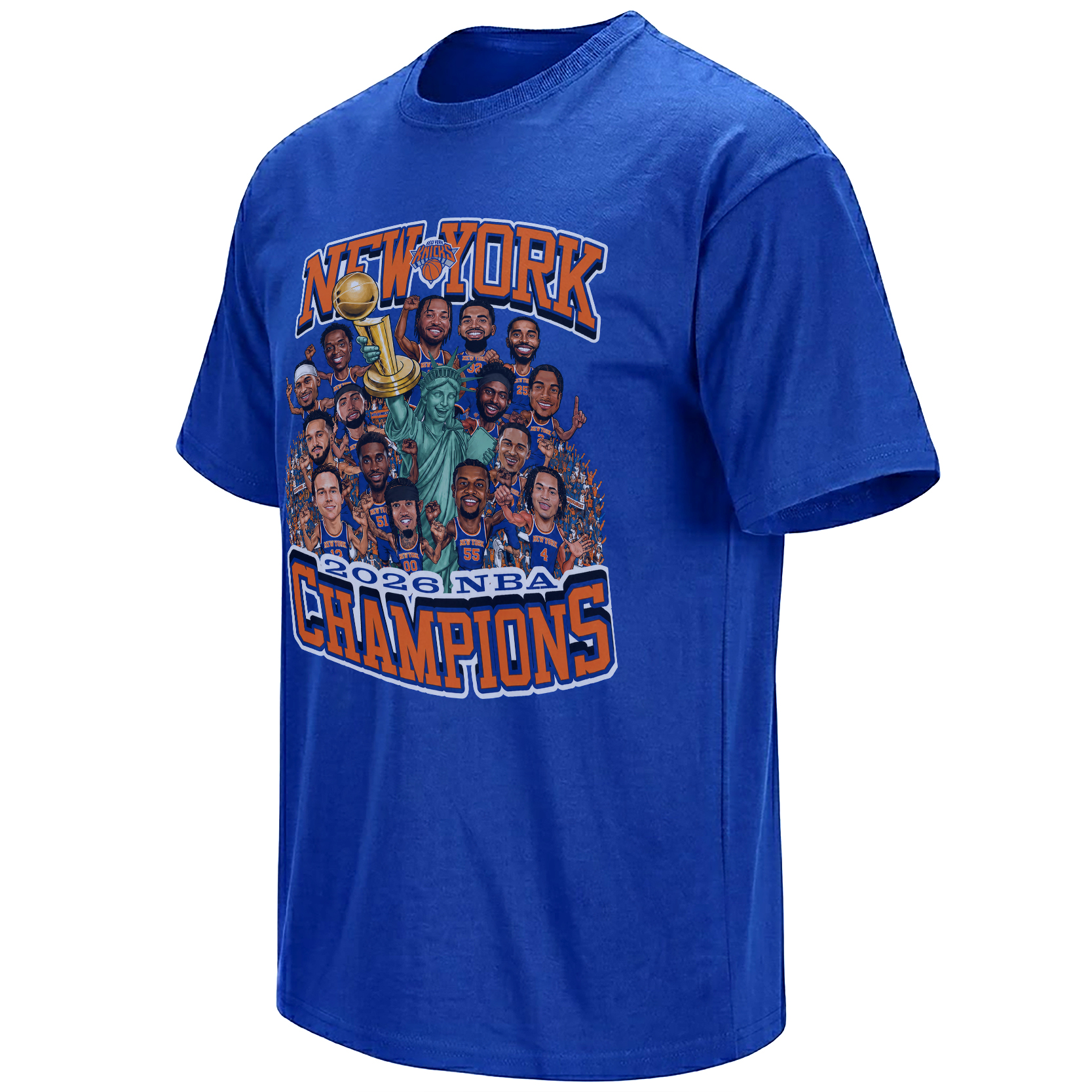
New York 2026 NBA Champions Shirt
A full-team championship caricature combining New York basketball typography, an oversized roster collage, the Larry O’Brien Trophy, the Statue of Liberty and orange-and-blue celebration graphics.
View the shirtThe Statue of Liberty Changes the Meaning of the Team Portrait
The most important artistic decision is the placement of the Statue of Liberty at the center of the roster. She turns a team celebration into a New York celebration.
Without the statue, the artwork would still communicate basketball success. With her, the image suggests that the championship belongs to the city itself. Her oxidized green surface interrupts the orange, blue and skin-tone palette, ensuring that the eye returns repeatedly to the center.
The torch rises almost parallel to the championship trophy. One object represents New York’s civic identity; the other represents the team’s sporting achievement. Placing them together makes the trophy feel like a second city landmark.
The Statue of Liberty lifts her torch while the championship trophy rises beside her. Together, they transform the player collage into a visual claim: basketball glory has returned to New York.
This approach also reflects how supporters experienced the title. The championship was discussed through landmarks, neighborhoods, bridges, subway lines and borough identity. The city was not merely where the Knicks played. It was an active character in the season.
Jalen Brunson Became the Face of the New York Revival
Every team portrait contains a figure viewers search for first, and in 2026 that figure is Jalen Brunson.
Brunson completed the Finals as the central force behind New York’s offense and received the Bill Russell NBA Finals MVP Trophy. His 45-point performance in the clinching Game 5 became a franchise Finals record and completed one of the most significant individual postseason runs in Knicks history.
Yet his importance cannot be expressed entirely through points. Brunson became the emotional organizer of the team. During difficult possessions, the ball returned to him. During comebacks, his calm prevented urgency from becoming panic. During the parade, he carried the trophy through a city that had spent decades imagining the sight.
That is why fan culture has continued expanding his image after the Finals. The “Brunson River” petition is playful, but it communicates something serious: supporters now place him beside the landmarks and names through which New York describes itself.
The Roster Collage Makes the Championship Feel Collective
Brunson may provide the emotional center, but the design refuses to let one player occupy the entire story.
Karl-Anthony Towns brought scoring range, size and a frontcourt matchup problem that altered the shape of New York’s offense. OG Anunoby became the defensive foundation and then produced the most replayed shot of the Finals. Josh Hart supplied rebounding, pressure, pace and the restless energy that repeatedly changed possessions. Mikal Bridges provided length, lineup flexibility and two-way stability.
Around them, the remaining roster appears as an illustrated wall of personalities. Headbands, facial hair, hairstyles, jersey numbers, pointing hands and raised fists help the viewer move through the group.
That crowded arrangement communicates something a list of names cannot: championship teams function through relationships. One player creates the shot. Another crashes the glass. Another makes the rotation. Another keeps the possession alive. Another remains ready when the series unexpectedly demands a larger role.
The gold championship trophy provides the result: New York finished the season at the top.
The overlapping caricatures preserve the idea that the title required an entire rotation, not one isolated hero.
The Statue of Liberty, crowd details and oversized New York lettering connect the team to all five boroughs.
Game 4 Became the Emotional Center of the Championship
The Knicks eventually won the Finals in five games, but the series will always bend around Game 4 at Madison Square Garden.
San Antonio scored 76 points in the first half and built a 29-point advantage. For most of the night, the Spurs controlled the scoreboard, the pace and the emotional atmosphere inside the arena.
New York then produced a comeback that became increasingly difficult to explain. Brunson attacked. Towns scored through pressure. Hart helped extend possessions. Anunoby defended, spaced the floor and remained active around the rim.
With the Knicks trailing in the final seconds, Brunson attempted a contested three-pointer. The shot missed. Anunoby arrived above the defense and redirected the ball through the basket with 1.2 seconds remaining.
New York’s first lead of the game became its final lead. The 107–106 victory completed the largest comeback in NBA Finals history and moved the Knicks within one win of the championship.
The ball from that tip-in has now become a protected franchise object. Its removal from a potential auction says something about the scale of the moment: certain artifacts are considered too important to disappear into a private collection.
Why the Caricature Style Fits the Way Fans Remember Sports
Sports memory is rarely perfectly proportioned. A great player becomes larger. A comeback becomes more impossible. A final second lasts longer. A crowd becomes louder each time the story is repeated.
Caricature works because it accepts that emotional exaggeration. Oversized heads make players immediately recognizable. Broad smiles communicate relief. Raised arms communicate victory before the viewer identifies a single face.
The illustrated treatment also allows the roster, Statue of Liberty, trophy and crowd to occupy the same space without needing to obey photographic realism. The design behaves like memory rather than documentation.
In memory, the entire team can stand together. The trophy can rise above everyone. Liberty can enter the photograph. A season can be compressed into one image without losing its emotional scale.
The Crowd Around the Players Is Part of the Story
Behind and around the roster, the artwork includes masses of orange-and-blue supporters. These smaller figures fill the empty spaces between players and prevent the collage from feeling like a studio portrait.
The crowd reminds the viewer that the championship was experienced collectively. Fans filled Madison Square Garden, bars, sidewalks, apartments and public viewing spaces. Each game reorganized evening plans across New York.
When the Knicks won, people did not simply observe the result. They entered it. Strangers embraced. Car horns became part of the celebration. Orange and blue appeared in neighborhoods far beyond the arena.
The illustrated crowd therefore performs an important role: it completes the team portrait by adding the people for whom the title mattered most.
From the Finals to the Canyon of Heroes
The championship moved from San Antonio to Manhattan, where the team traveled through the Canyon of Heroes during New York’s title parade.
The route transformed the roster into public figures beyond basketball. Brunson, Towns, Anunoby, Hart, Bridges and their teammates carried the trophy past supporters who had waited through multiple eras of the franchise.
For older fans, the parade connected 2026 to the 1973 champions. For younger supporters, it became the first time Knicks championship history existed as something they had witnessed rather than something they had inherited.
The roster caricature preserves that parade feeling. Everyone appears simultaneously, the city occupies the center and the trophy rises above the group as the object around which the entire composition organizes itself.
Four Shirt Colors, Four Different Visual Personalities
The same artwork changes character depending on the shirt color beneath it. Because the design contains orange, royal blue, white, gold and Liberty green, each background emphasizes a different part of the composition.
Royal blue offers the most immersive team-color presentation. The shirt and artwork become one continuous field of New York blue, allowing orange typography to dominate.
Black produces a more dramatic streetwear effect. Sport grey gives the design the feeling of a commemorative newspaper illustration, while white provides maximum separation between the individual caricatures.
Why a Full-Roster Shirt Can Age Better Than a Single-Player Moment
Player-specific shirts preserve one personality or one play. Full-roster designs preserve the ecosystem of a season.
Years from now, viewers may remember the 2026 Knicks through Brunson’s scoring, Anunoby’s tip-in or one particular Finals game. A roster collage allows those memories to coexist.
It also records the less obvious figures whose contributions become more appreciated over time. Rotations change, players move and statistics are eventually viewed from a historical distance. The group portrait maintains the feeling that, for one postseason, all of these personalities occupied the same story.
That makes the shirt suitable not only for the summer after the title but for future anniversaries, reunions and discussions about the team that ended the drought.
A Championship Design Built Around Recognition
The artwork rewards two different viewing distances. From across a room, the viewer sees “NEW YORK,” the trophy, the Statue of Liberty and “2026 NBA CHAMPIONS.”
From closer range, the smaller discoveries begin: individual jersey numbers, hairstyles, facial expressions, fists, pointing hands and miniature crowd figures.
This layered readability is essential for a roster caricature. The design must communicate the championship instantly while still giving fans reasons to continue studying the composition.
Every additional recognition creates a small moment of participation. The viewer does not merely look at the artwork. The viewer searches through it, naming players and reconnecting each face to a memory from the season.
The Championship Is Becoming New York Folklore
The weeks immediately after a title are when facts begin transforming into folklore.
The Game 4 comeback becomes “the night the Garden shook.” Anunoby’s tip-in becomes “the ball the franchise had to keep.” Brunson’s Finals run becomes large enough that fans imagine renaming a river for him.
These stories will continue growing because championships are retold through emotional compression. Supporters do not remember every possession equally. They select the moments that best explain what the team meant to them.
The caricature shirt participates in that process. It does not reproduce one exact photograph. It collects the season’s symbols and reorganizes them into a visual legend.
How to Wear a Graphic This Detailed
Because the design already contains a large roster, city landmark, trophy and multiple typography styles, it works best with simple surrounding pieces.
The royal-blue version pairs naturally with light or black denim, neutral sneakers and a simple jacket. The black shirt can support blue or orange accessories without becoming visually crowded.
Sport grey works well for a softer vintage look, while white is the easiest option for summer styling and parade-season outfits.
The design does not require additional basketball graphics around it. Its strength comes from behaving like an entire championship poster placed on the front of one shirt.
Continue exploring New York’s championship: Browse more player, roster and Finals artwork in the New York Knicks collection, explore the wider NBA collection, or visit designs centered on the 2026 NBA Finals Champions cultural moment.
What This Image May Mean Years From Now
In July 2026, the artwork feels immediate. The parade is recent. The Game 4 ball is still in the news. Brunson’s championship run remains part of daily New York conversation.
Years later, the same image may function differently. Fans may use it to remember the first title they experienced with their children, the bar where they watched the comeback or the family members who spent decades waiting for the Knicks to return.
The players will no longer occupy the same roster. The season will become a chapter in franchise history. Yet the caricature will continue presenting them as they were during the championship moment: together, surrounded by New York and beneath a trophy that had been absent for 53 years.
That is why the design feels larger than a standard championship logo. It does not simply say that New York won.
It shows the entire city entering the picture.
Frequently Asked Questions
What is the New York 2026 NBA Champions Shirt?
It is a New York basketball championship design featuring a full caricature roster, the Larry O’Brien Trophy, the Statue of Liberty, a fan crowd and large 2026 NBA Champions lettering.
Why is the Statue of Liberty included in the design?
The Statue of Liberty represents New York City and transforms the roster portrait into a citywide championship celebration rather than a standard team lineup.
Did the New York Knicks win the 2026 NBA championship?
Yes. New York defeated the San Antonio Spurs four games to one and won its first NBA championship since 1973.
Who won the 2026 NBA Finals MVP award?
Jalen Brunson won the Bill Russell NBA Finals MVP Trophy after leading New York through the championship series.
What happened in Game 4 of the 2026 NBA Finals?
The Knicks overcame a 29-point deficit and defeated San Antonio 107–106 after OG Anunoby tipped in Jalen Brunson’s missed shot with 1.2 seconds remaining.
Why is the Game 4 basketball important?
The ball was used for Anunoby’s historic game-winning tip-in. The NBA removed it from a planned auction so it could remain with the Knicks as a franchise artifact.
Which shirt colors are available?
The product is presented in royal blue, black, sport grey and white, with each color creating a different level of contrast around the roster and typography.
What makes this different from a standard championship shirt?
Instead of using only a trophy and team name, the artwork combines a large player caricature collage, city symbolism, crowd imagery and championship typography in one detailed composition.