South Side Magic: How Mike Vasil Turned a Toy Wand Into White Sox Folklore
Mike Vasil could not pitch for the Chicago White Sox while recovering from Tommy John surgery. Instead, he found another role: resident wizard, dugout energy source and keeper of the $20 wand that became one of baseball’s strangest—and most perfectly timed—rituals of 2026.
By late June, Mike Vasil’s wand had survived long enough to become more than a clubhouse joke. It had appeared beside home runs, a pointed wizard hat, broadcast conversations and a White Sox season whose surprising energy kept inviting the same question: what if the magic was real?
The ritual began on April 27, after reliever Jordan Leasure spent roughly $20 and had a toy wand sent to Chicago. Vasil, sidelined for the season following Tommy John surgery, took possession of it in the White Sox dugout and began performing mock spells during important at-bats.
The timing kept rewarding the joke. Chicago produced home runs, rallies and winning stretches while Vasil waved the wand. Munetaka Murakami was tapped on the helmet before a two-homer game against the Cubs. A wizard hat joined the ritual. Broadcasters noticed. Teammates encouraged it. What began as injury-season improvisation became a language the entire dugout could use.
The wand never needed to be real. It only needed the next home run to arrive before anyone stopped believing in it.
An Injured Pitcher Found a Different Way Into the Season
Vasil entered 2026 facing the kind of absence that can separate a player from the daily life of a team. He had undergone Tommy John surgery and was placed on the long-term injured list, removing him from the competitive role he had built during an effective 2025 season.
His teammates did not want him removed from their environment. Vasil’s energy, humor and clubhouse presence carried enough value that he remained around the team while recovering. That decision created the conditions for the wand ritual to exist.
Instead of disappearing into a private rehabilitation schedule, Vasil became unusually visible. He appeared in the dugout, joined broadcasts and participated in the emotional rhythm of games he could not enter. The wand gave that presence a recognizable form.
There is something distinctly baseball-like about the transformation. The sport is filled with players inventing ways to remain useful during periods when their conventional role is unavailable. Some become unofficial coaches. Some chart pitches. Some control music or celebrations. Vasil became a sorcerer.
The Wand Arrived at Exactly the Right Time
Clubhouse rituals do not become meaningful through intention alone. Someone can declare a lucky object on Monday, but if the team loses six straight games by Sunday, the mythology usually disappears.
Vasil’s wand received immediate statistical reinforcement. During the early period after it arrived, the White Sox went 13–5. The team was playing with energy, producing power and building a collective personality that contrasted sharply with the strain surrounding recent South Side seasons.
Every well-timed home run gave the ritual another chapter. The wand moved from joke to coincidence, from coincidence to superstition and from superstition to a symbol fans could recognize without seeing the entire sequence again.
The most memorable confirmation came during the Crosstown Classic. Before a game against the Cubs, Vasil tapped Murakami’s helmet with the wand. Murakami then produced his first two-homer game. Asked afterward whether the wand had helped, he agreed through his interpreter.
No one needed to claim supernatural causation. The humor depended on everyone understanding that baseball performance does not come from toy-store magic while behaving as though the evidence had become difficult to ignore.
A low-cost toy wand gave the ritual the correct visual absurdity. It looked unmistakably unserious inside a Major League dugout.
Home runs and wins repeatedly followed the performance closely enough for coincidence to become a continuing storyline.
Teammates, broadcasters and fans accepted the joke, allowing one player’s routine to become shared South Side language.
Why Baseball Always Leaves Room for Magic
Baseball presents itself as a sport of measurable probabilities. Every pitch, swing, launch angle and defensive route can be reduced to data. Yet the people inside the game continue to protect rituals that have no statistical explanation.
Players avoid stepping on foul lines. Hitters repeat the same glove adjustment. Teammates sit in assigned places during rallies. Fans wear the same jersey during winning streaks. These habits survive because baseball’s long schedule creates countless opportunities for coincidence to begin feeling personal.
The wand fits that tradition while making the superstition visible. Most baseball rituals are private or subtle. Vasil’s version involves an object designed to be waved, pointed and noticed by television cameras.
That visibility allowed the joke to spread beyond the dugout. Viewers could watch Vasil prepare a “spell,” see a hitter produce a big moment and connect the two events before the broadcast finished the replay. The ritual functioned almost like a live-action meme assembled during the game.
The wand belongs to the same emotional system as rally caps and lucky seats. Fans know the ritual cannot control the result, but abandoning it while the team is winning would feel unnecessarily dangerous.
From Tommy John Recovery to Resident Wizard
The most important part of the Vasil story is not the claim that the wand changed baseball games. It is the way an injured player changed his relationship to a lost season.
Tommy John recovery is repetitive, private and physically demanding. The player spends months working toward a return that remains too distant to provide daily competitive satisfaction. Vasil’s dugout role introduced performance, connection and immediate emotional feedback into that process.
When a teammate homered after a wand gesture, Vasil could celebrate a contribution that did not appear in a pitching line. When broadcasters invited him into the booth, the ritual gave him a story larger than an injury update. When fans began using wizard language, his rehabilitation season acquired a public identity.
This does not reduce his athletic role. Vasil had established himself as an effective pitcher before surgery and continued discussing the work required for his return. The magic-wand story exists alongside that baseball reality, not instead of it.
But sports culture often remembers the unexpected role as clearly as the planned one. Vasil entered the year as a rehabbing pitcher and became one of the most visible personality figures around a winning White Sox team.
The Ritual Became a Shared South Side Performance
A clubhouse joke becomes culture when other people begin adding to it. The wand was only the first object. A pointed wizard hat followed and became associated with home-run celebrations. Players acknowledged the spell. Broadcasts returned to the image. The team discussed the possibility of turning the wand into a fan giveaway.
Each addition expanded the ritual without making it too organized. The appeal came from its homemade quality. It did not arrive through a branding meeting or a carefully rehearsed campaign. A teammate ordered something inexpensive online, and the team allowed the meaning to grow through use.
That difference matters to fans. Official celebrations can be enjoyable, but spontaneous clubhouse habits feel like evidence that the players have developed an internal life beyond the schedule. They offer a glimpse of chemistry rather than a statement about chemistry.
The visual establishes the joke before the result and gives the audience something to watch beside the hitter.
A home run or rally transforms the performance from random dugout behavior into apparently successful sorcery.
The celebration completes the visual story and gives teammates a physical role inside the ritual.
Each successful sequence strengthens the mythology, even while everyone understands the comic premise.
When Opposing Broadcasts Started Noticing
The wand crossed an important threshold when it stopped being understood only by White Sox viewers. Opposing broadcasts began showing Vasil in the dugout and asking what he was holding.
That outside confusion improved the joke. Local fans already knew the rules, while visiting announcers experienced the ritual in real time. When another Chicago home run followed the wand’s appearance, the broadcast itself became part of the magic narrative.
Internet culture rewards moments that contain their own setup and reversal. A broadcaster questions the wand. Vasil keeps waving it. A hitter connects. The ball leaves the park. The skeptical commentary suddenly sounds like an invitation the baseball gods accepted.
Clips of those sequences could circulate without extensive explanation because the central contrast was immediately visible: a Major League game, an injured pitcher holding a toy wand and a result that seemed to validate the performance.
Why “South Side Magic” Became the Correct Phrase
“Mike Vasil’s magic wand” identifies the object and the person. “South Side Magic” expands the story into a team and city identity.
The phrase works because the ritual arrived during a broader change in White Sox atmosphere. Chicago was not treating the wand as entertainment during another joyless stretch. The team was winning, developing confidence and producing the kind of unpredictable moments that allow belief to move beyond one player.
South Side baseball has often carried an identity built around toughness, skepticism and the refusal to accept outside definitions of the team. Magic seems like an unusual addition to that language until the wizard is an injured pitcher wearing black and silver, waving a cheap wand from the dugout while the team keeps scoring.
The contrast makes the phrase stronger. It is not polished fantasy. It is South Side sorcery: improvised, funny, stubborn and effective often enough that nobody feels comfortable putting the wand away.
How the Artwork Turns the Dugout Joke Into Fantasy Baseball
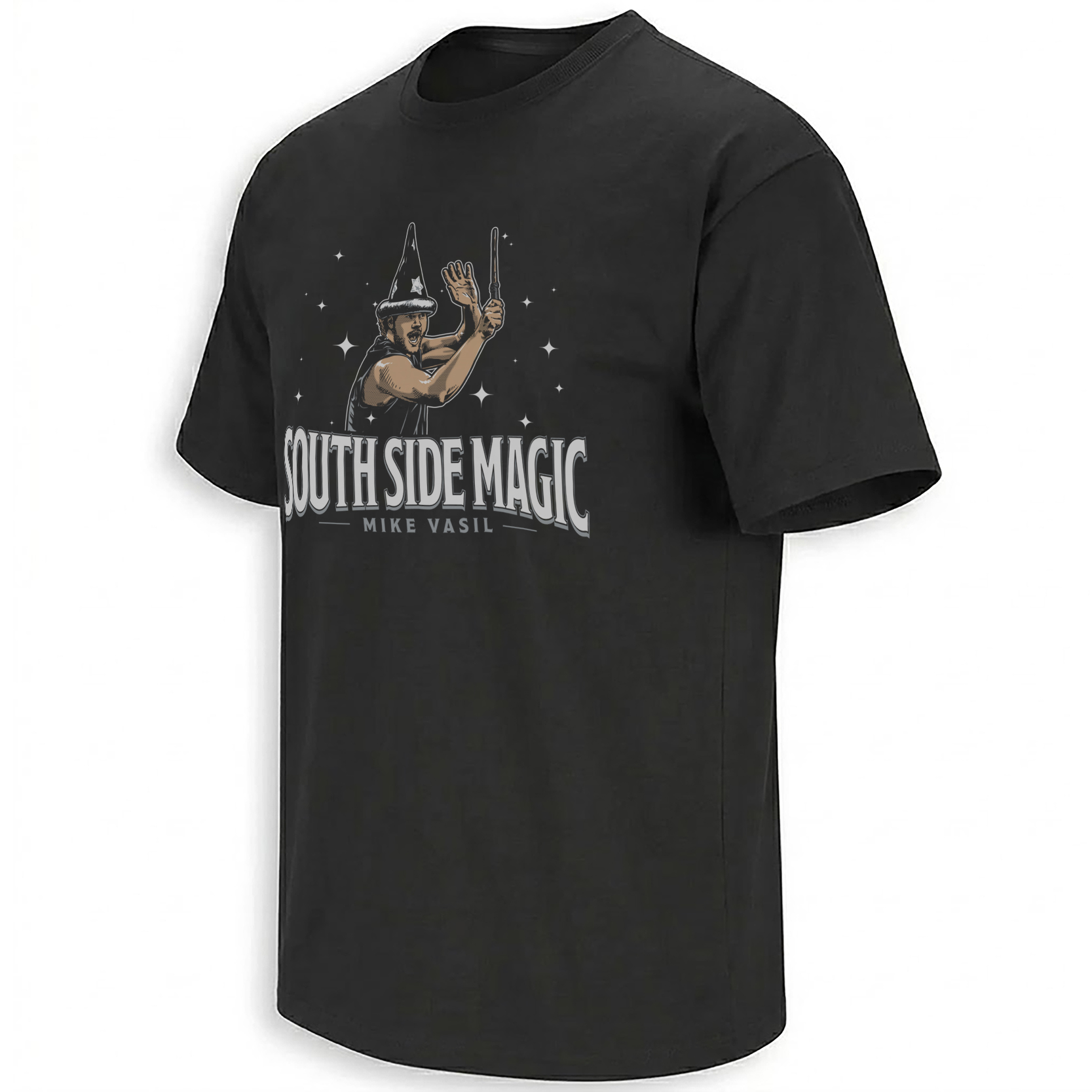
The South Side Magic design does not merely place a small wand beside a conventional player portrait. It rebuilds Vasil as the central figure in a baseball spell poster.
Vasil appears inside a pointed wizard hat, immediately establishing the clubhouse reference. One hand raises the wand, which produces a green burst of light rather than a realistic spark. The exaggerated glow makes the invisible idea of “clubhouse energy” visible.
The title curves across the upper composition in distressed gothic lettering. “South Side” anchors the location, while “Magic” receives the more theatrical treatment. The words read like the title of a fantasy film that somehow takes place inside the White Sox dugout.
Black, grey and silver preserve the White Sox visual environment. Electric green introduces the supernatural layer without replacing the team’s identity. Gold stars and spell particles soften the darker palette, giving the image the handmade theatricality of an old carnival poster or pulp-fantasy book cover.
The lower architecture combines baseball shapes with a Chicago city atmosphere. That mixture matters because the ritual belongs to a specific place. The wand may imitate fantasy language, but the story remains rooted in Rate Field, the South Side dugout and a White Sox season that developed its own emotional vocabulary.
The Design Records a Player Who Was Present Without Playing
Most player graphics celebrate visible performance: home runs, strikeouts, catches or championships. This one documents presence.
Vasil could not contribute innings during the 2026 season, yet he became culturally central to the team’s public image. The artwork records the alternative role he created rather than pretending the injury did not exist.
That makes the design unusual within sports memory. It is not a tribute to a statistic. It preserves the moment when rehabilitation, humor and clubhouse chemistry overlapped strongly enough to turn a sidelined pitcher into the unofficial magician of a contender.
The wand therefore becomes a symbol of adaptation. Vasil lost access to the mound but not to the team. He found a way to remain part of the action, and the White Sox allowed that contribution to become visible rather than treating it as a distraction.
A White Sox Season Told Through Its Strange Little Rituals
Winning teams are eventually summarized through standings, stars and postseason results. While a season is still unfolding, fans often experience it through smaller details: a dugout celebration, a repeated phrase, a player’s handshake or an object that keeps appearing near important moments.
The wand became one of those details. It connected Murakami’s power, Vasil’s rehabilitation, teammate chemistry and the fan base’s willingness to enjoy a season that felt increasingly different from recent White Sox history.
Ellie Shirt’s Chicago White Sox collection follows that developing South Side language through player moments, team slogans and graphics inspired by the rituals surrounding Chicago’s 2026 run.
The broader MLB collection places the magic-wand story inside baseball’s wider culture of superstition, dugout humor and strange objects that become meaningful because players keep winning near them.
Frequently Asked Questions
Why does Mike Vasil have a magic wand in the White Sox dugout?
White Sox reliever Jordan Leasure ordered a toy wand for roughly $20 in April 2026. Vasil began waving it during important at-bats while recovering from Tommy John surgery, and the routine became a recurring dugout ritual.
When did the White Sox magic-wand ritual begin?
The wand became part of the White Sox dugout during a home series beginning April 27, 2026, and gained attention as Chicago continued producing wins and well-timed home runs.
Did Mike Vasil use the wand before a Munetaka Murakami home run?
Yes. Vasil tapped Murakami’s helmet with the wand before a May game against the Cubs, and Murakami went on to record his first two-homer game of the season.
Why was Mike Vasil in the dugout if he could not pitch?
Vasil was recovering from Tommy John surgery, but his teammates and the organization valued his energy and clubhouse presence. He remained around the team while completing his rehabilitation work.
What does “South Side Magic” mean?
The phrase describes the combination of White Sox winning momentum, clubhouse chemistry, dramatic home runs and the playful belief surrounding Vasil’s wand and wizard-hat ritual.
Why did the wand become popular with White Sox fans?
The ritual was visually funny, easy to recognize and repeatedly followed by successful moments. It gave fans a shared superstition that represented the team’s improved energy during the 2026 season.
What does the South Side Magic design represent?
The artwork turns Vasil’s real dugout ritual into a fantasy-baseball portrait, combining his wizard hat, raised wand, green spell effects and Chicago imagery as a visual record of the 2026 White Sox clubhouse.
The South Side Magic design preserves Mike Vasil’s unexpected role as Chicago’s resident dugout wizard, while the wider White Sox visual archive follows the players, rituals and belief systems shaping the team’s 2026 identity.
South Side Magic Shirt captures Mike Vasil’s viral White Sox dugout ritual through a wizard hat, glowing wand, gothic baseball lettering and the playful superstition that followed Chicago’s 2026 home runs and winning momentum.