
Sooner Magic Takes Over Omaha
Oklahoma turned an uneven season into a championship eruption, beat North Carolina 13–2 in the deciding game and brought its third baseball national title home from Omaha.
The final score looked less like the end of a championship series than the last statement of a team that had spent the entire postseason becoming more dangerous. Oklahoma defeated North Carolina 13–2 on June 22 at Charles Schwab Field Omaha and claimed the third baseball national championship in program history.
The Sooners finished the job with 14 hits, two home runs and enough offense to remove almost all uncertainty before the final innings arrived. Kyle Branch drove in six runs. Dayton Tockey homered. LJ Mercurius steadied the game from the bullpen. Jackson Cleveland struck out the final three hitters.
When the final strike crossed the plate, Oklahoma’s title years no longer stopped at 1951 and 1994.
The new line read: 1951. 1994. 2026.
That complete championship timeline is spread across the Oklahoma Sooners 2026 Champions Hawaiian Shirt. Its crimson all-over print does not isolate one trophy or one final score. It collects the language, symbols and attitude surrounding the entire run.
OklaOmaha. Sooner Magic. National Champions. Yesterday Is Dead.
The Sooners produced 14 hits in the decisive third game and completed one of the most explosive NCAA Tournament runs of the season.
A Team That Became Something Else in June
Oklahoma did not arrive at the NCAA Tournament carrying the polished profile of an obvious national champion.
The Sooners had absorbed the week-to-week difficulty of SEC baseball, finished below .500 in conference play and entered the national tournament without a protected seed. Their road required travel, elimination pressure and repeated victories over opponents the selection committee had ranked ahead of them.
That is where the season changed.
Oklahoma defeated Georgia Tech twice in the Atlanta Regional, including an extra-inning victory that kept the postseason alive. The Sooners then traveled to Kansas and swept the nationally seeded Jayhawks in the Super Regional.
By the time OU reached Omaha, the regular-season version of the team had largely disappeared.
The lineup was hitting for power. Young pitchers were handling major assignments. The bullpen was closing games. Every victory appeared to create another layer of confidence.
“Sooner Magic” stopped functioning as an inherited slogan.
It became a description of what was happening.
Oklahoma did not carry a perfect season into Omaha. It carried a postseason version of itself that no opponent could slow down.
The Road Through the National Seeds
A championship run gains weight through the opponents left behind.
Oklahoma’s path included victories over the No. 2, No. 3, No. 5, No. 7 and No. 15 national seeds. The Sooners did not slip through an empty portion of the bracket. They repeatedly defeated teams that had spent the season building stronger national résumés.
Why “OklaOmaha” Became the Perfect Championship Word
College baseball has spent decades turning Omaha into more than a tournament location.
Reaching the city represents survival through regionals and super regionals. Winning there requires navigating unfamiliar opponents, compressed pitching decisions and the pressure of knowing that every game is being absorbed into program history.
“OklaOmaha” merges that destination with the identity of the team that conquered it.
The word is playful, but it also acts like a territorial claim. Oklahoma did not merely visit Omaha in 2026. The Sooners occupied it long enough to leave with the trophy.
That makes the phrase especially effective inside the shirt pattern. It appears beside championship shields, baseballs, bats and OU marks, allowing the location of the victory to become part of the visual celebration.
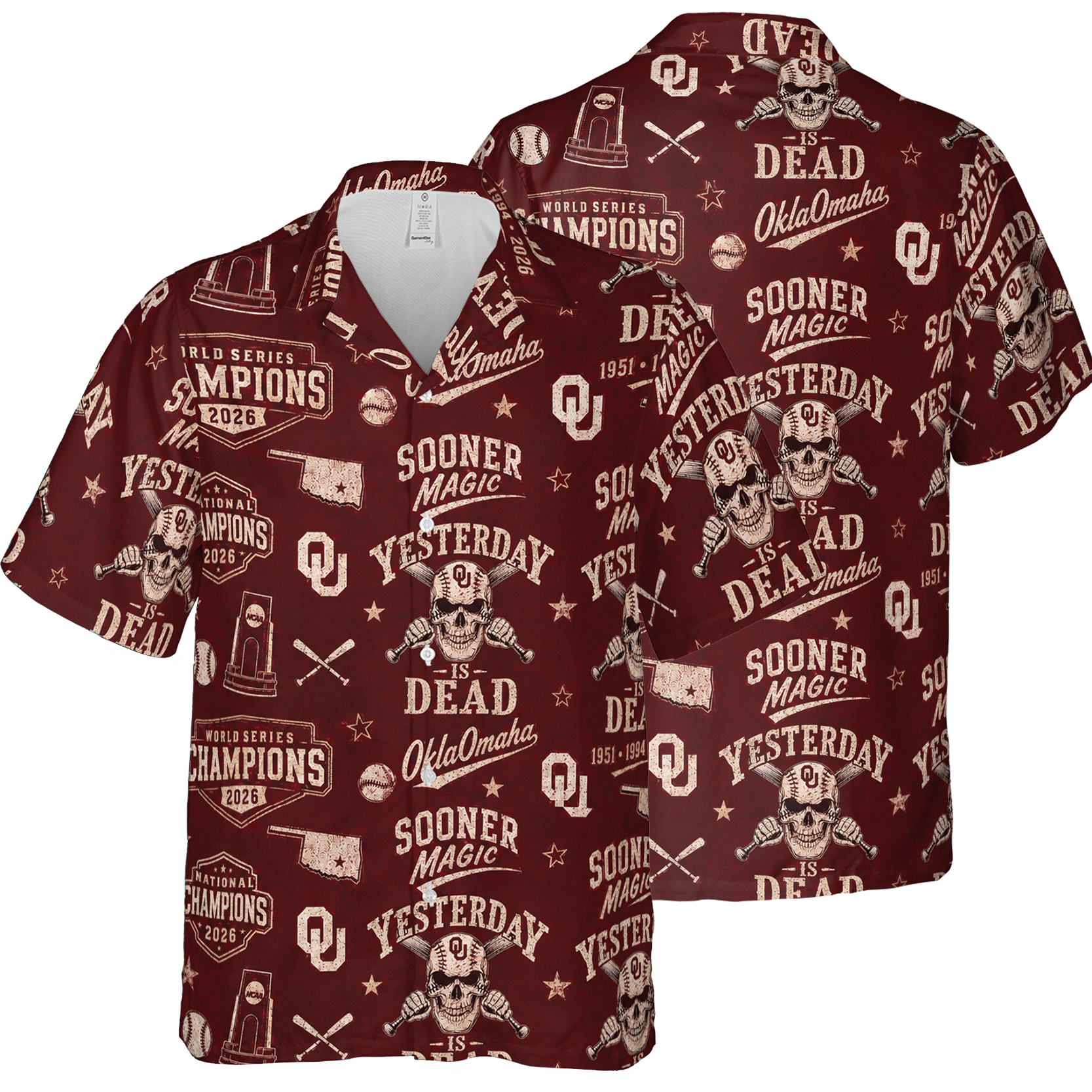
Oklahoma Sooners 2026 Champions Hawaiian Shirt
A crimson front-and-back pattern combining OklaOmaha script, Sooner Magic lettering, championship trophies, crossed bats, baseballs, Oklahoma maps and 2026 national-title badges.
The “Yesterday Is Dead” skull artwork gives the design a harder vintage edge, turning the end of Oklahoma’s 32-year baseball title wait into a declaration rather than a quiet historical reference.
View the Hawaiian shirt“Yesterday Is Dead” Changes the Meaning of the Pattern
The most aggressive image on the shirt is not the trophy.
It is the skull wearing an Oklahoma baseball cap, positioned over crossed bats and framed by the words “Yesterday Is Dead.”
On the surface, the artwork resembles a vintage baseball-pirate emblem. Within the championship story, the phrase carries a more specific meaning.
Oklahoma entered 2026 with a proud baseball history but no national championship since 1994. The program had returned to the Finals in 2022, only to finish as the national runner-up. That recent experience proved the Sooners could return to the sport’s final stage without guaranteeing that they would complete the journey.
The 2026 team ended both conversations.
The 32-year wait was over. The loss in the 2022 Finals no longer represented the latest word on Oklahoma baseball in Omaha.
Yesterday was dead because the present had produced another trophy.
“Yesterday Is Dead” transforms the shirt from a conventional championship collage into a statement about replacing old disappointment with a new historical fact. Oklahoma’s most recent College World Series ending is no longer a runner-up finish—it is the 2026 national title.
The Pattern Reads Like a Championship Newspaper
A traditional championship tee usually presents one headline.
This all-over print presents an entire front page.
“World Series Champions 2026” supplies the main announcement. “National Champions” confirms the official achievement. OklaOmaha provides the location. Sooner Magic supplies the emotional explanation. The skull artwork provides attitude. The years 1951, 1994 and 2026 place the new title inside a larger program history.
Baseballs, stars, crossed bats, trophy illustrations and Oklahoma maps fill the spaces between those messages.
The viewer does not absorb every element at once. The first impression is unmistakably crimson and championship-driven. A closer look reveals a sequence of smaller references.
That discovery effect gives the garment more depth than a single oversized logo.
The Front and Back Form One Continuous Celebration
The product is designed as a true all-over-print Hawaiian shirt rather than a standard button-up with one graphic placed on the chest.
Its visual language continues across the front panels, short sleeves, collar and back. Championship badges and skull graphics do not disappear when the wearer turns around. OklaOmaha and Sooner Magic remain visible from multiple directions.
That continuity changes how the shirt works in a crowd.
At a championship gathering, summer cookout or Oklahoma baseball event, the design remains active while the wearer is facing a conversation, watching a game or standing inside a group photograph.
The back is not secondary space.
It is another page of the same championship story.
Crimson Makes the Shirt Feel Historical
Oklahoma crimson gives the pattern its immediate identity, but the darker shade also determines the mood.
A brighter tropical background would make the design feel purely seasonal. The deep crimson base makes it feel closer to an old pennant, weathered baseball program or vintage collegiate poster.
Cream and muted tan artwork sit on top of that background with deliberately distressed textures. The print appears aged even though the championship is new.
That contrast is important.
The shirt celebrates a current title while presenting it as something already worthy of the historical archive.
Oklahoma won in June 2026, but the design visually places the achievement beside 1951 and 1994 from the beginning.
Jaxon Willits Owned the Omaha Stage
Every championship run produces one player whose performance becomes inseparable from the tournament.
For Oklahoma, that player was Jaxon Willits.
The junior shortstop was named the Men’s College World Series Most Outstanding Player after batting .500 across six games in Omaha. He produced 13 hits—the most ever by an Oklahoma player during one College World Series—and reached base five times in the championship clincher.
Willits did not need one isolated swing to define his tournament.
His value came through accumulation: repeated hits, doubles, walks, runs and the pressure created every time he returned to the plate. He became the dependable center of an offense that had transformed itself into one of the most powerful groups in the tournament.
The third championship links Skip Johnson’s team to two earlier generations while giving modern Sooners fans a title they experienced in real time.
Kyle Branch Delivered the Final Explosion
The decisive championship game belonged statistically to Kyle Branch.
Branch went 3-for-4 and drove in six runs, producing the best offensive performance of his career on the night Oklahoma needed one final victory.
His three-run homer in the eighth inning pushed the score to 13–2 and removed any remaining tension from the final moments. The shot was more than insurance. It became the punctuation mark at the end of the title run.
Branch’s performance captured the wider nature of the team.
The Sooners did not depend on one established superstar to rescue them every night. Different players produced the necessary swing, defensive play or pitching appearance as the tournament moved forward.
That balance made Oklahoma increasingly difficult to eliminate.
The Bullpen Preserved the Championship
Oklahoma’s offense generated the largest numbers, but the title also depended on the calm work of the pitching staff.
True freshman Nick Wesloski made the start in the deciding game before LJ Mercurius entered with one out in the third inning. Mercurius allowed only one run across 5.2 innings, struck out five and gave the lineup time to expand the lead.
Jackson Cleveland handled the ninth.
After allowing a leadoff single, Cleveland struck out three consecutive North Carolina hitters. The final two watched strike three. Oklahoma’s championship ended not with a ball in play, but with a pitcher controlling the last confrontation completely.
That sequence gave the celebration a clean final image.
Glove closed. Arms raised. Sooners rushing toward the mound.
Why the Hawaiian Format Fits College World Series Culture
Omaha takes place at the beginning of summer, after the normal rhythm of campus life has slowed and college baseball has become the center of the sporting calendar.
Fans travel, gather outdoors, move between games and spend days inside an atmosphere that feels closer to a baseball festival than a conventional tournament.
A Hawaiian shirt belongs naturally within that environment.
Its open collar and repeated pattern feel suited to warm weather, road trips, watch parties, vacation weekends and championship celebrations. It can function as game-day apparel without carrying the formal look of a jersey.
For Oklahoma fans, the format also matches the emotional release that followed the title.
The team had already done the serious work.
The shirt belongs to the part where everyone gets to enjoy it.
A championship tee records the result. A championship Hawaiian shirt turns the entire summer into part of the celebration.
A Shirt for Norman After Omaha
The title celebration did not remain in Nebraska.
Oklahoma returned home to a championship event at Kimrey Family Stadium, where the team, supporters and trophy gathered in the same place. The run that had unfolded across Atlanta, Lawrence and Omaha became a Norman memory.
That return completed the cultural journey represented by the shirt.
OklaOmaha names the place where the championship was won. OU marks and the Oklahoma map identify where the trophy belongs afterward.
The all-over pattern keeps both locations visible at once.
Omaha supplied the stage.
Oklahoma supplied the champion.
The Design Connects Three Championship Generations
Baseball history can become difficult to wear when a design focuses entirely on dates.
The Hawaiian shirt solves that problem by placing the years inside a larger visual system.
The references to 1951, 1994 and 2026 are surrounded by skulls, bats, trophies, stars and Oklahoma imagery. The championship timeline is present, but it does not feel like a museum label.
Older fans can read the newest title beside the teams they already remembered. Younger supporters receive a visual reminder that the 2026 trophy extends an existing tradition rather than beginning one.
The new title also changes the weight of the earlier years.
Oklahoma baseball history no longer feels like two distant peaks separated from the present.
The present has joined them.
Why the Pattern Can Outlast the Championship Week
Event-specific merchandise is often strongest during the days immediately following the victory.
An all-over-print Hawaiian shirt has a longer social life because its use is not limited to one ceremony or one stadium.
It can return for summer gatherings, alumni events, baseball weekends, vacations, championship anniversaries and future trips to Omaha. The shirt remains visually interesting even after the championship is no longer breaking news.
Over time, its phrases may become even more meaningful.
“Sooner Magic” will recall the transformation that took place during the postseason. “OklaOmaha” will recover the city and tournament. “Yesterday Is Dead” will remember the point when a 32-year wait ended.
The design preserves not only what happened, but how the run felt.
Explore More Oklahoma Championship Culture
The Oklahoma Sooners 2026 Champions Hawaiian Shirt belongs to a wider collection documenting the title through trophy graphics, OklaOmaha wordplay, championship bears, stitched emblems and designs inspired by the final celebration.
Explore more Oklahoma baseball and championship apparel through the collections below.
Oklahoma’s season did not move in a straight line toward the trophy.
It survived difficult stretches, entered the tournament without the protection of a national seed and traveled through a bracket filled with teams expected to advance further.
Then the Sooners began hitting.
They beat Georgia Tech. They swept Kansas. They shut out Alabama. They defeated Georgia twice. They recovered from losing the second championship game and overwhelmed North Carolina in the third.
By the end, there was nothing mysterious about why Oklahoma had won.
The pitching held. The lineup erupted. The final strike landed.
Sooner Magic had become championship history.
Oklahoma Champions Hawaiian Shirt FAQ
Did Oklahoma win the 2026 College World Series?
Yes. Oklahoma defeated North Carolina 13–2 in the winner-take-all third game of the championship series to win the 2026 NCAA Division I baseball national title.
How many baseball national championships has Oklahoma won?
Oklahoma has won three baseball national championships: 1951, 1994 and 2026.
Who was the 2026 College World Series Most Outstanding Player?
Oklahoma shortstop Jaxon Willits received the award after batting .500 with 13 hits across six games in Omaha.
What does “OklaOmaha” mean?
“OklaOmaha” combines Oklahoma with Omaha, Nebraska, the city where the Men’s College World Series championship is decided.
What does “Yesterday Is Dead” mean on the shirt?
The phrase celebrates Oklahoma replacing its previous title drought and 2022 runner-up finish with a new championship ending in 2026.
Does the Oklahoma Hawaiian shirt include a back design?
Yes. It is a coordinated all-over print with championship artwork continuing across the front, back, collar and sleeves.
What appears in the Hawaiian shirt pattern?
The pattern includes championship badges, trophies, OU marks, Oklahoma maps, baseballs, crossed bats, OklaOmaha lettering, Sooner Magic and “Yesterday Is Dead” skull artwork.
Where can the Oklahoma champions Hawaiian shirt be worn?
It is suited to championship celebrations, summer parties, baseball watch gatherings, vacations, alumni events and future Oklahoma game days.