
Doomed At the Dome
Before conference realignment redrew college basketball, the road to Syracuse ended beneath a white roof, inside a wall of noise and beside a growing graveyard of Big East rivals.
The Dome was never built like a conventional basketball arena. It was too large, too strange and too closely tied to one program’s identity. The court occupied one end of a building designed to hold football crowds, yet on winter nights it became the center of the Big East universe.
Visiting teams entered beneath the roof carrying rankings, stars and national ambitions. They also entered a building where more than 30,000 people could turn a routine conference game into something that felt closer to a regional emergency.
That atmosphere created the mythology behind one of Syracuse basketball’s most memorable vintage slogans:
Doomed at the Dome.
The phrase was a warning, a boast and a piece of old-school rivalry humor. It imagined the Carrier Dome as a basketball graveyard where Georgetown, Connecticut, Villanova, St. John’s and the rest of the old Big East arrived with confidence and left behind another headstone.
A fan declaration that visiting Big East opponents entered Syracuse’s massive home arena at their own risk—and often became the latest victims of the Orange, the crowd and one of college basketball’s most unusual environments.
The Big East Was Built for Buildings Like This
The original Big East did not feel like a collection of schools sharing a schedule. It felt like a network of territories.
Georgetown had Washington. St. John’s owned a piece of Madison Square Garden. Villanova carried Philadelphia. Connecticut brought New England intensity. Syracuse had the Dome.
Those locations mattered because the conference’s identity was inseparable from place. Games were shaped by crowded student sections, hostile road environments and fan bases that remembered every slight from the previous decade.
The Dome amplified that culture through scale.
Syracuse could draw crowds larger than many professional teams while still preserving the emotional tension of a college rivalry. The fans were not positioned closely around all four sides of the floor, but the building created another kind of pressure. Noise accumulated beneath the roof. Orange filled the field of vision. A successful run could make the size of the arena feel suddenly personal.
Opponents did not merely play Syracuse.
They played the idea that the entire building was beginning to move against them.
The Dome was enormous enough to feel impersonal before tipoff—and loud enough to feel like every person inside had chosen one visitor to blame.
The Graveyard Printed on the Shirt
The artwork turns that history into a cartoon cemetery.
The Dome rises behind eight headstones, each marked with an old conference opponent and the same final verdict: R.I.P.
The point was never that Syracuse defeated every opponent every time. Rivalries only become meaningful when both sides are capable of causing pain.
The graveyard represents the emotional truth of home-court mythology. Fans do not memorialize balanced historical records on a T-shirt. They remember the nights when the crowd took over, the zone defense swallowed an opponent and another ranked visitor walked away stunned.
Each stone is therefore less like a statistical claim and more like a chapter marker from an era when those names appeared repeatedly on Syracuse’s winter calendar.
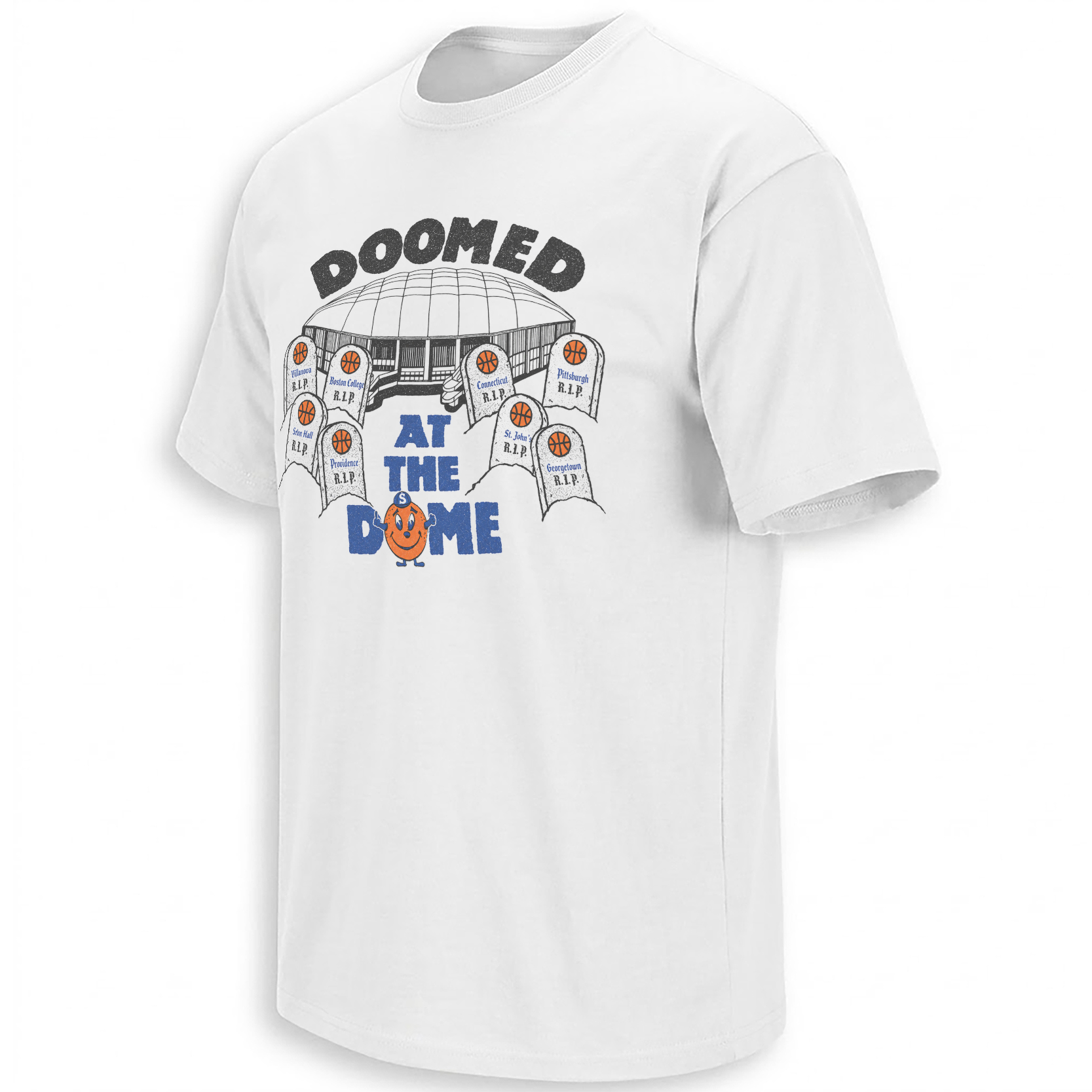
Doomed at the Dome Shirt
The design recreates a vintage Syracuse basketball concept with the Dome positioned behind a cemetery of Big East rivals, including Georgetown, Connecticut, Villanova, Pittsburgh and St. John’s.
Distressed black lettering, hand-drawn headstones and a restrained orange-and-blue palette give the artwork the feel of an old campus shirt discovered in a box from the height of Big East basketball.
View the shirtGeorgetown: The Rivalry That Defined the Warning
No headstone carries more emotional weight than Georgetown.
Syracuse and Georgetown became opposites large enough to define the early Big East. The programs represented different cities, coaching personalities and basketball identities. John Thompson’s Hoyas were physical, intimidating and nationally powerful. Jim Boeheim’s Syracuse teams played with length, shooting and the famous 2–3 zone.
The rivalry contained stars, technical fouls, tournament meetings and genuine dislike. Georgetown’s victory in the final regular-season game at Manley Field House in 1980 inspired the declaration that the Hoyas had closed the building.
The Dome gave Syracuse a new stage on which to answer.
When Georgetown came north, the crowd understood that the game meant more than another line in the standings. It was an argument about which program controlled the conference and which side would be forced to hear about the result until the next meeting.
Connecticut: The Rival That Never Stayed Gone
The UConn rivalry developed differently.
As Connecticut grew from regional opponent into a national championship power, meetings with Syracuse gained greater consequences. Both programs recruited the Northeast. Both expected to compete near the top of the conference. Both developed fan bases with long memories.
The series produced physical regular-season games and unforgettable Big East Tournament moments, including the six-overtime epic at Madison Square Garden in 2009.
Even after conference realignment separated the programs, the rivalry remained culturally alive. The announcement of a Syracuse–UConn exhibition at Mohegan Sun in October 2026 immediately revived interest because the names still carry the sound of the old conference.
The schedule can change. The emotional reflex does not.
Villanova, St. John’s and the Rest of the Neighborhood
The brilliance of the graveyard design is that it does not reduce Syracuse history to two rivalries.
Villanova appears because the Wildcats were present from the conference’s early years and repeatedly challenged Syracuse with guard play, discipline and postseason ambition. Syracuse defeated Villanova in a three-overtime game to win the 1981 Big East Tournament championship inside the Dome, giving the building an important conference memory almost immediately after it opened.
St. John’s carried New York City, Lou Carnesecca and generations of metropolitan basketball credibility. Games against Syracuse connected upstate New York to Madison Square Garden and turned recruiting geography into rivalry geography.
Pittsburgh brought another kind of tension. The Panthers became known for difficult, physical games in which every rebound seemed to require negotiation.
Providence, Seton Hall and Boston College completed the old neighborhood. Each program belonged to a conference structure that felt regional enough for familiarity and large enough for national relevance.
The headstones work together because they reconstruct that world.
The Dome Was a Character, Not Only a Venue
Most arenas host history without becoming characters within it.
The Dome was different.
Its air-supported roof, enormous seating capacity and multipurpose design made it instantly recognizable. Basketball occupied only a portion of the building, but the crowd transformed that unusual layout into an advantage.
Television broadcasts regularly emphasized the attendance. Wide camera shots showed an ocean of spectators rising behind the court. Announcers discussed the noise, the shooting background and the emotional effect of a massive home crowd.
The building also became inseparable from Jim Boeheim.
Boeheim coached Syracuse from 1976 through 2023, spending nearly his entire head-coaching career walking the same sideline. In 2002, the basketball surface was formally named Jim Boeheim Court, placing his identity directly beneath every game played there.
Players changed. Conferences changed. The roof changed. The official name changed from Carrier Dome to JMA Wireless Dome.
The basic association remained untouched.
Syracuse basketball lived in the Dome.
The venue became the JMA Wireless Dome in 2022, but “Carrier Dome” remains deeply embedded in Syracuse basketball memory. Vintage graphics such as “Doomed at the Dome” naturally connect to the original name because they evoke the years when the air-supported roof, Boeheim’s zone and Big East rivalries defined the building.
The 2–3 Zone Made the Graveyard Feel Real
The Dome’s mythology was not built through architecture alone.
Syracuse required a basketball identity capable of making visitors uncomfortable, and Boeheim’s 2–3 zone became that identity.
Opponents entered knowing what they would face. The Orange would stretch long defenders across the perimeter, protect the lane, invite particular shots and attempt to turn every pass into hesitation.
Preparation did not guarantee comfort.
The unusual sightlines and large crowd could make an early missed three-pointer feel heavier. One Syracuse run could force a timeout. The crowd would rise, the zone would appear wider and an offense that had practiced against five defenders suddenly seemed to be playing against the building.
That is the deeper joke behind the graveyard.
Teams knew where the traps were located. They still walked into them.
The Dome did not hide Syracuse’s plan. It made a familiar plan feel larger, louder and more difficult to escape.
Why the Artwork Looks Like a Lost Campus Classic
The design avoids the polished appearance of modern championship merchandise.
Its lettering is rough. The Dome is drawn through simple black lines. The headstones lean slightly rather than forming a perfectly symmetrical cemetery. Small orange basketballs replace formal grave markers.
Those imperfections are essential.
The image resembles a shirt created for a student section, campus bookstore or rivalry weekend decades ago. It feels connected to the period when sports graphics were expected to communicate one aggressive joke rather than function like corporate branding.
“Doomed” arches above the building in distressed black type. “At the Dome” appears beneath it in Syracuse blue, with the Orange mascot standing inside the final line as though personally responsible for the cemetery.
The layout is playful rather than threatening. It converts fierce conference history into the visual language of a newspaper cartoon or hand-drawn game-day flyer.
A Shirt About a Conference Syracuse Left—but Never Lost
Syracuse departed the Big East for the ACC in 2013.
The move created new schedules, new recruiting conversations and new annual opponents. Games against Duke, North Carolina, Virginia and other ACC programs brought national attention of their own.
Yet the old Big East remains unusually powerful within Syracuse culture because it shaped the program’s emotional identity.
The conference was where Boeheim built Syracuse into a national power. It supplied the rivals supporters learned to dislike before many of them understood the standings. It connected regular-season games to Madison Square Garden and made winter basketball in the Northeast feel like its own ecosystem.
Leaving the conference ended the annual schedule.
It did not erase the neighborhood.
That is why meetings with Georgetown still matter. It is why the 2026 exhibition against UConn attracted immediate attention. It is why a graveyard filled with old Big East names remains understandable more than a decade after realignment.
Nostalgia Works Because the Rivalries Were Specific
Sports nostalgia becomes weak when it celebrates only a general idea of the past.
“Doomed at the Dome” is effective because it names the opponents.
A Syracuse supporter can look at Georgetown and remember one set of games. Connecticut unlocks another era. Villanova suggests tournament battles and skilled guards. Pittsburgh recalls defensive wrestling matches. St. John’s brings New York and Madison Square Garden back into view.
The design functions like a map of memory.
Each headstone creates a path toward a player, coach, upset, argument or family story. Older fans recognize the original environment. Younger fans receive a visual introduction to the rivalries that built the program they inherited.
The shirt is therefore not only about defeating opponents.
It is about remembering who the opponents were.
Why the Phrase Can Still Belong to the Modern Dome
The current building is not identical to the one that opened in 1980.
Renovations replaced the original air-supported roof with a permanent structure, introduced new video boards and modernized the experience. The name changed. Syracuse changed conferences. Boeheim retired.
A venue can evolve without losing its mythology.
The phrase “Doomed at the Dome” remains available whenever Syracuse creates another overwhelming home night. It can be used historically, as the artwork does, or applied to a future opponent discovering that the building still carries emotional weight.
The cemetery belongs to the Big East era, but the warning does not require retirement.
Every generation of Syracuse basketball has the opportunity to add another imaginary stone.
Explore More Syracuse and College Basketball Culture
The Doomed at the Dome design belongs to a broader category of college basketball graphics that preserve buildings, rivalries and regional identities rather than focusing only on individual players.
Explore more Syracuse-inspired designs and college basketball culture through the collections below.
The old Big East cannot be reconstructed exactly.
Conferences are different. Buildings are renamed. Coaches retire. Rivalries appear less frequently than they once did.
But the right image can bring the atmosphere back.
A white roof. A packed crowd. Eight familiar opponents. Orange basketballs carved into fictional headstones.
And above the entire scene, the message visiting teams were supposed to understand before they stepped onto Jim Boeheim Court:
Doomed at the Dome.
Doomed at the Dome FAQ
What does “Doomed at the Dome” mean?
“Doomed at the Dome” is a vintage Syracuse basketball slogan presenting the Dome as a hostile home court where visiting opponents, especially old Big East rivals, were expected to lose.
Which teams appear on the gravestones?
The artwork includes Villanova, Boston College, Connecticut, Pittsburgh, Seton Hall, Providence, St. John’s and Georgetown.
Is the Carrier Dome still called the Carrier Dome?
The building was renamed the JMA Wireless Dome in 2022. Many fans still use the former Carrier Dome name when discussing historic Syracuse basketball moments.
When did the Dome open?
The venue opened in September 1980 and quickly became the home of Syracuse football, basketball and lacrosse.
Why was the Dome difficult for visiting basketball teams?
Its enormous crowds, unusual basketball layout, loud indoor environment and Syracuse’s distinctive 2–3 zone helped create one of college basketball’s most recognizable home-court settings.
Why are Georgetown and UConn important Syracuse rivals?
Georgetown helped define the early Big East rivalry era, while UConn developed into another major regional and national opponent through repeated regular-season and tournament meetings.
Does Syracuse still play in the Big East?
No. Syracuse left the Big East and joined the Atlantic Coast Conference in 2013, although former Big East rivalries remain an important part of the program’s identity.
What is featured on the Doomed at the Dome Shirt?
The design features a hand-drawn Dome, distressed “Doomed at the Dome” lettering, the Syracuse Orange mascot and gravestones representing eight former Big East opponents.