
Mike Vasil and the Magic Wand: How an Injured Pitcher Became the White Sox Dugout Wizard
Mike Vasil cannot throw a competitive pitch for Chicago in 2026, yet he has become one of the season’s most visible White Sox personalities. A $20 wand, an overnight delivery and a clubhouse willing to believe in its own joke transformed rehabilitation into South Side folklore.
On June 26, the Chicago White Sox scored 22 runs against Kansas City, launched five home runs and produced their largest offensive outburst in more than half a century. Mike Vasil watched from the dugout, where the wand and its home-run-only sorcerer’s hat received nearly constant work.
Two days later, Chicago closed the weekend at 43–39 after taking another home series. The club had won ten consecutive series at Rate Field, a franchise record, and had transformed itself from a rebuilding afterthought into one of the American League’s most surprising first-half stories.
Vasil had not contributed an inning to that record. Tommy John surgery during Spring Training placed him on the injured list for the season. Yet the pitcher remained with the team, brought energy to the clubhouse, joined broadcasts, celebrated home runs and waved a wand that teammates increasingly treated as part joke, part ritual and part explanation for everything unexpectedly going right.
The wand became believable not because anyone thought it controlled baseball, but because it gave a young team a visible symbol for how much fun winning had become.
The Origin Story Cost Twenty Dollars
Baseball mythology usually improves with age. Details become less practical, coincidences become destiny and the object at the center of the story begins to feel as though it had always been waiting for the team that discovered it.
The White Sox wand arrived through a less romantic process. Reliever Jordan Leasure found it on Amazon, spent $20, requested overnight shipping and gave it to Vasil before Chicago opened a home series against the Angels on April 27.
That ordinary beginning is essential to the charm. The object was not recovered from an old stadium locker or handed down through generations of South Side pitchers. It was inexpensive, quickly delivered and immediately available for improvisation.
Jordan Leasure purchased the wand as a dugout joke while both he and Vasil were dealing with significant injuries.
The rehabbing pitcher gave the object personality through exaggerated motions, timing and a willingness to commit fully to the bit.
Chicago’s strong home run and walk-off stretch allowed coincidence to become ritual and ritual to become a season-long identity.
Broadcast shots, social clips, home-run celebrations and discussion of a possible giveaway moved the wand beyond the dugout.
Why Mike Vasil Was the Right Person to Hold It
A prop does not become culture by itself. Someone has to understand when to reveal it, how seriously to perform the joke and how to keep repetition from making the ritual feel forced.
Vasil had already established himself as one of Chicago’s most energetic personalities during his 2025 rookie season. The right-hander worked as both starter and reliever, finishing with a 2.50 ERA across 101 innings and becoming part of the group expected to help the organization move forward.
Tommy John surgery changed the visible path of his 2026 season. Instead of taking the mound, he faced months of rehabilitation and the isolating reality of being unable to contribute in the way a pitcher normally measures value.
The White Sox chose to keep him with the major-league club. Teammates wanted his energy present. Manager Will Venable wanted him around the group. Vasil responded by treating participation as broader than pitching.
The wand matters because Vasil refused to become invisible during rehabilitation. He found a way to remain emotionally active inside the season even when his throwing arm could not participate.
The Magic Appeared Beside Munetaka Murakami
The wand gained public momentum during a May home series against the Cubs. Vasil tapped Munetaka Murakami on the hat before the game, and the Japanese slugger responded with his first two-homer performance in Major League Baseball.
The sequence gave the ritual exactly what every baseball superstition needs: a result dramatic enough to be replayed and specific enough to remember.
On May 16, television cameras captured Vasil waving the wand before Murakami launched his 16th home run. MLB’s own highlight presentation described the moment as the power of the wand continuing its magic.
Murakami joined the joke rather than resisting it. Asked whether the wand had helped, he agreed. That participation expanded the ritual from Vasil’s performance into a team language.
The Artwork Treats the Story Like a Lost Fantasy Novel
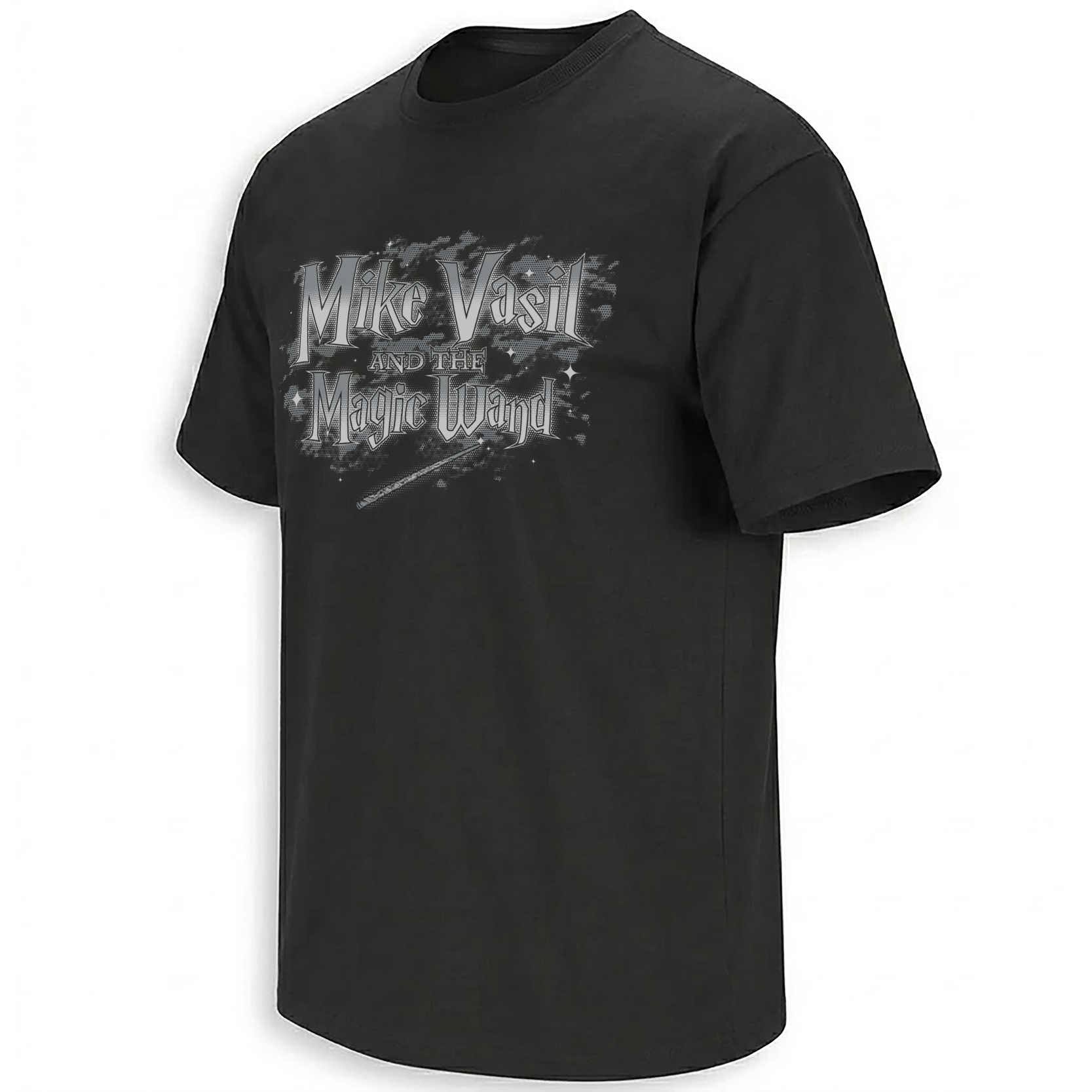
The Mike Vasil and the Magic Wand graphic understands that the humor becomes stronger when presented with unnecessary seriousness. Instead of resembling an ordinary baseball slogan, the title looks like the cover of a dark fantasy book discovered in the back of the clubhouse.
Gothic silver lettering gives Vasil’s name the scale of a fictional hero. “And the Magic Wand” turns one inexpensive dugout object into the central artifact of an adventure. Stars, smoky texture and the illustrated wand complete the illusion.
The black base is especially effective. White Sox culture already carries a monochrome identity, so the fantasy treatment does not feel imported from an unrelated visual world. It reads like South Side baseball passing through a spellbook.
The Hat Made Home Runs Part of the Ritual
Every successful piece of baseball folklore acquires additional rules. The White Sox eventually added a sorcerer’s hat, but it was not treated as ordinary dugout clothing. The hat belonged specifically to home runs.
That limitation gave the prop ceremonial value. If the hat appeared, something important had happened. It converted the home-run celebration into a small theatrical performance and gave cameras another recognizable image to locate.
During Chicago’s 22–1 victory over Kansas City, five different White Sox hitters homered. Miguel Vargas, Tristan Peters, Jacob Gonzalez, Kyle Teel and Andrew Benintendi repeatedly gave the dugout wizard work to perform.
The exaggerated score did not prove supernatural intervention. It gave the mythology its most extravagant chapter.
Vasil Even Called a Home Run Before It Happened
The most effective legends survive because reality occasionally produces a coincidence too perfect to ignore.
During the 22-run outburst, Vasil was wearing a microphone for an all-access broadcast segment. Seconds before Miguel Vargas drove a three-run home run during Chicago’s ten-run third inning, Vasil called the shot.
Baseball prediction is rarely that cooperative. A hitter can receive hundreds of pitches without producing the exact event someone announces from the dugout. When the prediction and swing aligned, the wand’s fictional résumé gained another entry.
The moment also showed why Vasil had become valuable to broadcasts. He did not merely explain pitch selection or repeat safe clubhouse language. He understood entertainment, timing and the pleasure of letting baseball remain ridiculous.
An Injured Player Became a Cultural Contributor
Professional sports often describe availability as the central form of value. Players help by entering games. Injured players recover outside the main narrative and wait until they can return.
Vasil’s season complicates that assumption. He cannot improve Chicago’s bullpen ERA or protect a lead, but he can influence how the team experiences the work.
His presence offers continuity between the active roster and the injured group. His humor creates shared language. His enthusiasm gives teammates permission to celebrate without becoming self-conscious.
None of those contributions replace pitching. Vasil has acknowledged that the season would be more enjoyable if he could play. The emotional force of the story comes from his willingness to contribute while still wanting the role temporarily unavailable to him.
The wand lets an injured pitcher remain visible, connected and useful while completing one of baseball’s most demanding rehabilitation processes.
Players can participate without explanation, turning daily baseball tension into a ritual understood by the group.
The object represents a team that began winning, drawing larger crowds and becoming emotionally enjoyable again.
The Wand Works Because the Team Is Winning
Losing teams can create entertaining rituals, but repeated defeat changes how the audience interprets them. Fun risks looking like distraction when the scoreboard provides no evidence of progress.
Chicago’s 2026 improvement gave the wand credibility within fan culture. The team began the year exceeding expectations, played especially well at Rate Field and remained inside the American League Central race as June ended.
Walk-offs, home runs and strong home series allowed the ritual to attach itself to real competitive momentum. The wand did not create the wins, but it appeared beside enough of them to become shorthand for the mood.
That distinction explains why the object spread beyond the clubhouse. Fans were not embracing random comedy from a struggling team. They were embracing a symbol of the season beginning to feel possible again.
The 2026 White Sox Needed a Different Emotional Identity
Recent seasons had trained White Sox supporters to approach optimism carefully. Rebuilding language, roster turnover and heavy loss totals created distance between the team and parts of its fan base.
The 2026 club could not repair that relationship through marketing language alone. It needed to play harder, win more games and develop personalities supporters could recognize.
The wand became useful because it represented all three developments at once. It belonged to an injured player committed to the group. It appeared during victories. It gave a young roster a personality beyond prospect rankings and transaction analysis.
Mike Vasil became the unlikely face of that change precisely because he was not forcing himself into the story through statistics.
Baseball Has Always Needed Superstition
Baseball players operate inside a sport where success and failure can be separated by fractions of an inch. A well-hit ball becomes an out. A broken bat produces the winning run. A hitter makes the same swing on consecutive pitches and receives completely different results.
Ritual provides emotional structure when rational control is limited. Players repeat meals, clothing choices, routes to the stadium, pregame handshakes and dugout celebrations because repetition makes uncertainty feel more manageable.
The White Sox wand belongs to that long tradition, even though everyone understands its theatrical nature. The players do not need to believe in literal magic for the ritual to influence the atmosphere.
The object gives the group something to anticipate. It makes a home run feel like the completion of a shared joke. It turns the dugout from a waiting area into a stage.
Why the Give-Away Discussion Matters
By mid-June, the White Sox were openly discussing whether some version of the wand could become a stadium giveaway. The possibility marked a major cultural transition.
Clubhouse rituals usually begin as private language. Fans see fragments through television cameras, but the object remains owned by the players. A giveaway would distribute that language across the ballpark.
Tens of thousands of fans waving wands during a meaningful September or October game would transform Vasil’s prop into coordinated crowd behavior. What began with one Amazon order could become an alternative to the traditional White Sox blackout.
Whether the giveaway ultimately occurs is less important than the fact that the organization considered it. The wand had become significant enough to imagine at stadium scale.
A potential wand giveaway would complete the ritual’s cultural path: purchased by a teammate, performed by Vasil, adopted by the clubhouse and finally placed in the hands of White Sox fans.
The Story Is About Rehabilitation Without Isolation
Tommy John recovery is often described through throwing schedules, range-of-motion work and projected return dates. Those details explain the medical process but not the emotional cost.
Pitchers lose the routine around which their professional identity is organized. They cannot prepare for the next appearance, feel the game through competition or receive immediate evidence that rehabilitation is working.
Remaining with the major-league club gives Vasil access to the season’s daily rhythm. He travels, watches hitters, studies games and maintains relationships with teammates rather than experiencing recovery as a separate year.
The wand makes that inclusion visible. It tells the audience that Vasil is not absent from the 2026 White Sox story simply because his official stat line remains empty.
The Fantasy Typography Makes the Joke Feel Permanent
Dugout jokes often disappear when the season ends. They survive only in scattered clips or the memories of players who understood the original context.
The graphic gives this ritual a title. “Mike Vasil and the Magic Wand” sounds like the name of a self-contained story rather than one minor detail from a long schedule.
That naming process matters. It allows supporters to remember the season through an object and protagonist. The 2026 White Sox become the team with the dugout wizard, not merely the club associated with a temporary prop.
Fantasy lettering also protects the humor from becoming too literal. The design does not claim Vasil is responsible for Chicago’s home runs. It asks viewers to enjoy the exaggerated possibility.
The Wand Belongs to a Wider White Sox Personality Shift
Vasil’s sorcery exists alongside other rituals that made the 2026 club feel unusually expressive. Sam Antonacci bowed to Murakami at home plate. Miguel Vargas barked after home runs. Players developed handshakes and shared meals away from the ballpark.
These details matter because baseball seasons are too long to survive through intensity alone. Teams spend far more time together than the televised game reveals. Clubhouse culture determines whether that time creates connection or fatigue.
Chicago’s rituals provided evidence that the roster genuinely enjoyed one another. Executives, players and coaches repeatedly described the atmosphere as organic rather than manufactured for cameras.
The wand became the most visually efficient symbol of that larger environment.
Why the Story Resonates Beyond Chicago
Fans understand the experience of being temporarily unable to perform the role that normally defines them. Injury is specific to Vasil, but disruption is universal.
His response offers a recognizable form of resilience without turning recovery into sentimental perfection. He would rather pitch. He is still completing difficult rehabilitation. He also refuses to wait passively for usefulness to return.
That balance gives the story emotional weight beneath the comedy. The wand is funny because Vasil commits to it. It is meaningful because the commitment emerges from a season he could easily have experienced as lost.
A South Side Artifact, Not a Product Pitch
The Mike Vasil and the Magic Wand graphic belongs to a specific cultural moment: an injured pitcher becoming a dugout celebrity while Chicago unexpectedly moved into contention.
Within the wider MLB Shirts archive, the concept illustrates how baseball memory is often preserved through details that never appear in a box score—props, celebrations, predictions, nicknames and the private language that gradually becomes public.
A conventional team graphic can record the roster or final record. This design records what the season felt like from the dugout.
Why the Wand Can Outlast the 2026 Standings
Chicago’s final position in the division will determine how the season is classified historically. A postseason appearance would make the wand part of a breakthrough year. A second-half decline would place it inside a surprising but incomplete run.
The cultural meaning does not depend entirely on that outcome. Vasil has already shown that a player can shape a team without entering the game. The wand has already become recognizable enough to inspire official coverage and giveaway discussion.
Years later, the object may recall the precise summer when White Sox baseball became fun again—when a young roster won at home, fans returned in greater numbers and one rehabbing pitcher treated the dugout like a place where imagination could affect the atmosphere.
The magic was never inside the plastic wand. It was inside the decision to keep believing that participation remained possible.
Frequently Asked Questions
Why does Mike Vasil have a magic wand in the White Sox dugout?
White Sox reliever Jordan Leasure purchased the wand for about $20 and had it delivered before an April 27 home series. Vasil adopted it as a playful dugout ritual connected with home runs and winning moments.
Is Mike Vasil pitching for Chicago during the 2026 season?
No. Vasil is recovering from Tommy John surgery performed during Spring Training and is expected to miss the season, although he has remained with the major-league club.
What happened when Vasil used the wand with Munetaka Murakami?
Vasil tapped Murakami with the wand before the slugger recorded his first two-home-run MLB game, helping the ritual gain wider attention.
What is the sorcerer’s hat used for?
The White Sox added a wizard-style hat to the ritual, with the hat reserved specifically for home-run celebrations.
Did Mike Vasil predict a White Sox home run?
During Chicago’s 22–1 victory over Kansas City on June 26, Vasil called Miguel Vargas’ three-run home run seconds before it happened while wearing a microphone for the broadcast.
Have the White Sox discussed giving magic wands to fans?
Yes. White Sox officials and Vasil publicly discussed the possibility of a future wand giveaway, although no final promotional date had been confirmed.
What does the Mike Vasil and the Magic Wand design represent?
The fantasy-style graphic preserves Vasil’s 2026 dugout role, Chicago’s unexpected success and the clubhouse ritual that became a symbol of South Side energy.
The Mike Vasil and the Magic Wand piece preserves the strange, joyful ritual behind Chicago’s 2026 rise—a $20 prop transformed by timing, teammates and one injured player’s refusal to disappear from the season.
Mike Vasil Magic Wand Shirt captures the Chicago White Sox pitcher’s viral 2026 dugout ritual through dark fantasy lettering, silver magical texture and the wand that became a symbol of home runs, clubhouse chemistry and South Side winning energy.