Zendaya’s Vintage Spider-Man Shirt: The $35 Paris Look That Rewrote Superhero Dressing
Zendaya arrived at a Paris photocall for Spider-Man: Brand New Day wearing an oversized vintage Spider-Man T-shirt sourced from eBay. Styled with white heels and little else, the affordable fan artifact became the sharpest fashion statement of the press tour.
Zendaya’s most revealing Spider-Man: Brand New Day press-tour look was not a web-covered couture gown, a custom runway commission or a dress built through months of archival research.
It was a vintage T-shirt purchased on eBay for approximately $35.
At a Paris photocall on June 24, 2026, Zendaya wore an oversized black Spider-Man graphic tee as a minidress, pairing it with clean white Christian Louboutin heels, diamond earrings and a polished beauty look. The contrast immediately transformed the shirt from casual fan clothing into a deliberate red-carpet argument.
In one image, the moment brought together celebrity method dressing, internet vintage hunting, comic-book nostalgia and a franchise relationship that has followed Zendaya since she first appeared as Michelle Jones in Spider-Man: Homecoming.
The outfit was inexpensive by luxury-event standards, but culturally expensive. It carried the history of Spider-Man graphics, the emotional uncertainty surrounding MJ’s return and the larger question at the center of Brand New Day: what remains when Peter Parker must begin again?
The most powerful luxury choice was proving that a fan-found vintage T-shirt could hold the same room as couture.
Paris • Spider-Man: Brand New Day press tourThe Paris Look Worked Because It Refused to Look Expensive
Zendaya and stylist Law Roach have built one of modern celebrity fashion’s most recognizable creative partnerships. Their press-tour wardrobes often operate as visual extensions of the films being promoted.
For Dune, silhouettes, metallic surfaces and desert references reflected the world of Arrakis. For Challengers, tennis whites, nets and court-green details transformed athletic language into luxury fashion. Spider-Man naturally invites red, blue, web patterns and comic-book construction.
The Paris T-shirt disrupted that expected escalation. Rather than attempting to create the most elaborate Spider-Man reference possible, the look returned to the type of object ordinary fans have used for decades: a printed tee discovered online.
That accessibility did not make the styling careless. The shirt’s oversized scale created the minidress silhouette. White stilettos sharpened the proportions and prevented the outfit from reading like an accidental off-duty look. Jewelry and controlled makeup maintained the visual language of a formal appearance.
The styling effectively placed a mass-cultural object inside a high-fashion frame. The T-shirt remained recognizable as fan apparel, but Zendaya’s presentation changed how seriously the object could be read.
A vintage Spider-Man graphic supplied the emotional credibility of something found rather than newly manufactured for the carpet.
Oversized proportions, bare legs and white stilettos converted the casual tee into a controlled Paris photocall silhouette.
A low-cost eBay discovery occupied the same visual space normally reserved for custom luxury houses and archival couture.
A $35 Shirt Became the Tour’s Most Democratic Fashion Story
The reported price became central to the coverage because celebrity press tours usually depend on economic distance. Custom garments, major jewelry houses and designer loans create looks that audiences can view but rarely reproduce.
The vintage Spider-Man tee entered the opposite direction. It came from eBay, a marketplace defined by searching, chance, condition and individual sellers rather than controlled luxury distribution.
The discovery suggested that cultural value and retail price do not always move together. A shirt can be inexpensive because it was overlooked, previously owned or created before anyone understood how relevant its image might later become.
Once Zendaya wore it in Paris, the object acquired a new biography. It was no longer merely an older Spider-Man shirt. It became the shirt from the Brand New Day press tour, documented by fashion publications and circulated across social platforms.
This is one of the defining mechanics of vintage culture. The original object remains physically unchanged, but a new wearer and new context can transform its symbolic value almost instantly.
The shirt’s power did not come from its original price. It came from the rarity of the graphic, Zendaya’s relationship with the franchise and Law Roach’s decision to place an ordinary fan object at the center of a major international press appearance.
Why Spider-Man Is Especially Suited to T-Shirt Culture
Spider-Man has always existed unusually close to everyday clothing. His suit is iconic, but Peter Parker’s identity is defined by ordinary life: school, rent, work, relationships and the pressure of keeping responsibilities hidden beneath normal appearance.
That duality makes the T-shirt a natural Spider-Man object. It is accessible, wearable and capable of carrying a superhero image without requiring the wearer to become a costume participant.
Vintage Spider-Man graphics also contain decades of changing visual language. Some resemble comic panels. Others use muscular 1990s illustration, simplified television-animation forms or distressed souvenir typography.
Each version records how a specific era imagined the character. A vintage tee is therefore not only apparel with Spider-Man printed on it. It is a portable fragment of franchise history.
Zendaya’s Paris look understood that history without requiring explanation. The shirt worked precisely because it looked like an object that had lived before the press tour.
The Moment Extended Zendaya’s Method-Dressing Legacy
Method dressing has become the popular term for promotional fashion that draws directly from the world, colors or characters of a project.
Zendaya and Law Roach did not invent the idea, but their work has helped turn it into one of the most closely followed forms of entertainment marketing. The outfits become parallel content: a second narrative running beside trailers, interviews and premieres.
The strongest examples avoid looking like literal costumes. They translate rather than copy. A color palette, texture, silhouette or archival reference can evoke a film without reproducing a character’s wardrobe.
The Paris Spider-Man tee operated differently because it approached literalness from the opposite direction. The graphic directly referenced the character, yet the styling transformed the object far beyond conventional fan wear.
Instead of couture imitating a comic-book world, ordinary merchandise entered couture space.
Rather than asking a luxury house to reinterpret Spider-Man, the Paris look allowed an existing fan artifact to lead. The fashion came from proportion, contrast and context—not from disguising the shirt’s popular origins.
Brand New Day Gives the Look Emotional Weight
The title Spider-Man: Brand New Day describes more than a new installment. The film begins from the consequences of No Way Home, where the world forgot Peter Parker’s identity.
Marvel’s official description places Peter alone in New York, committed to full-time crime-fighting while the pressure surrounding Spider-Man intensifies and a surprising physical evolution threatens his existence.
That setup makes MJ’s return especially charged. Zendaya is confirmed in the cast, but the emotional relationship established across the previous films cannot simply resume from the point where audiences left it.
Peter remembers. MJ does not share the same memory. Every interaction therefore carries the possibility that a familiar relationship may need to be rebuilt without the history that originally created it.
Against that narrative, Zendaya wearing Spider-Man’s image becomes more than a promotional joke. The shirt visually reconnects her with a character her screen counterpart may no longer recognize in the same way.
The Paris Setting Made the Contrast Stronger
Paris carries its own fashion mythology. Photocalls in the city are naturally interpreted through histories of couture, luxury houses, editorial styling and European image-making.
Wearing an inexpensive vintage superhero tee in that environment creates tension between cultural categories. Comic-book merchandise is associated with fandom and mass entertainment. Paris fashion is associated with exclusivity and high design.
Zendaya’s look refused the idea that those worlds must remain separate. The shirt could retain its fan identity while functioning as the central object of a polished fashion image.
The white heels were crucial to that translation. They introduced visual precision and separated the oversized black tee from ordinary streetwear styling.
The result did not mock luxury fashion or pretend a T-shirt requires no styling knowledge. It demonstrated that context, confidence and proportion can give an inexpensive object visual authority.
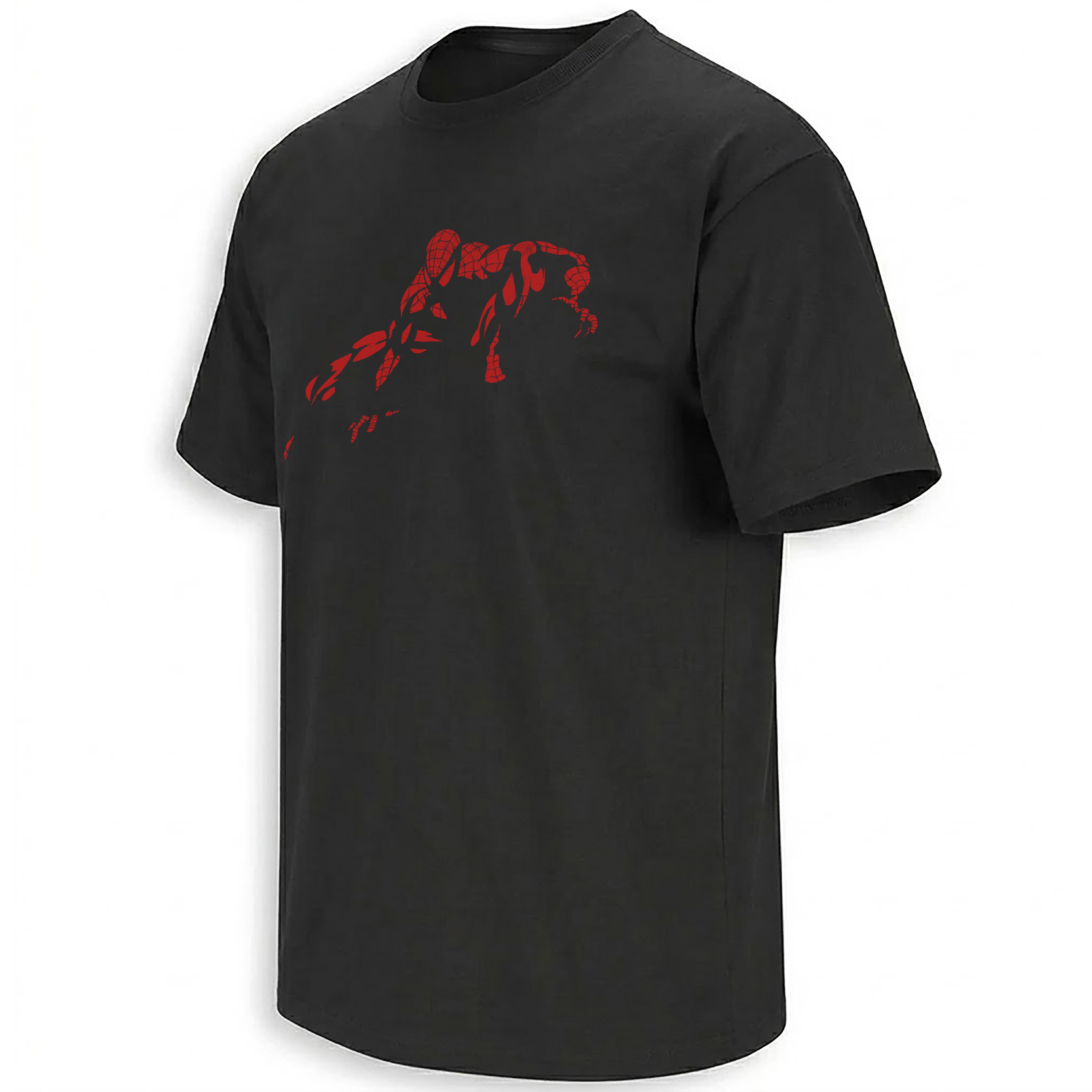
The Artwork Reframes the Moment as a Vintage Paris Poster
The design does not merely reproduce a photograph of Zendaya wearing Spider-Man imagery. It treats the appearance as though it had already entered cultural memory.
Distressed texture gives the composition the surface of an older cinema poster or fashion magazine page rescued from an archive. The wear is symbolic rather than documentary, allowing a June 2026 event to acquire the visual language of a remembered classic.
Zendaya functions as the central fashion figure, while the Spider-Man reference supplies the narrative around her. Paris adds a third layer, locating the moment within a city already associated with style history.
The balance matters. Too much superhero imagery would turn the design into a standard franchise graphic. Too much fashion language would erase the fan object that made the event distinctive.
The artwork succeeds by preserving the collision: movie promotion, celebrity style and vintage T-shirt culture occupying the same frame.
Why the Shirt Felt More Personal Than a Custom Gown
Zendaya’s history with Spider-Man is unusually layered. The franchise helped establish a major part of her film career, introduced her creative relationship with Tom Holland to global audiences and gave her a character whose emotional importance expanded across three films.
A custom Spider-Man-inspired gown could celebrate the new movie through craftsmanship and spectacle. A vintage tee communicates affection differently.
It resembles something a fan might own, search for or wear repeatedly. That familiarity creates an impression of personal attachment even when the styling is carefully constructed for publicity.
The shirt also references Spider-Man rather than centering MJ alone. Zendaya visually placed the hero’s image on her own body during a story in which Peter’s connection to MJ has been severed.
The result felt intimate without requiring a verbal explanation. Fashion performed part of the emotional work normally assigned to an interview.
Vintage Fashion Depends on Objects Having More Than One Life
New merchandise begins with a controlled purpose. It is produced for a specific release window, customer and marketing strategy.
Vintage objects operate less predictably. They move through owners, closets, resale platforms and changing cultural contexts. Their relevance can disappear and later return for reasons nobody involved in the original production could anticipate.
The Spider-Man shirt worn in Paris may have begun as ordinary franchise apparel. Years later, its age became part of its appeal. The graphic offered visual difference from current official merchandise precisely because it belonged to another design period.
Zendaya’s appearance supplied another life. The shirt became evidence that digital resale platforms can function as informal archives, preserving objects until a new moment makes them culturally visible again.
That process is central to the fascination surrounding vintage tees. The fabric carries wear, but the image carries time.
The Press Tour Is Already Building a Visual Story
Brand New Day promotion has treated clothing as a continuing narrative rather than a sequence of unrelated appearances.
Zendaya has moved through red-and-blue references, web-like detailing, archival silhouettes and fashion-house interpretations connected to Spider-Man’s visual world.
Each appearance adjusts the balance between character, celebrity and designer. Some looks begin with color. Others use construction or thematic accessories.
The Paris tee became distinctive because it reduced that machinery to one recognizable object. The shirt did not require audiences to decode a subtle reference. Spider-Man was visibly present.
Yet the look remained consistent with Zendaya’s broader press-tour identity because the simplicity was strategic. After multiple elaborate appearances, understatement became its own form of escalation.
Why the Internet Responded So Quickly
The outfit contained nearly every element needed for rapid online circulation: a globally recognizable celebrity, a major franchise, an accessible price, a vintage discovery story and a styling decision that could be understood from one image.
The reported eBay price added immediate contrast. Audiences accustomed to red-carpet looks valued in thousands of dollars could discuss an object closer to ordinary shopping budgets.
The simplicity also made the appearance easy to remix into headlines. Zendaya wore a Spider-Man T-shirt as a dress. The sentence requires no fashion vocabulary before the image becomes clear.
Social platforms reward that clarity, but the attention lasted because the look supported deeper readings: method dressing, vintage culture, MJ’s return and the democratization of celebrity styling.
A viral outfit can be simple without being shallow.
From Fan Merchandise to Cultural Artifact
The difference between merchandise and artifact is often time plus context.
Merchandise is created to participate in a current release. An artifact survives long enough to reveal something about how an era represented its characters, celebrities and fans.
The Paris shirt crossed that boundary publicly. Its older Spider-Man graphic became the center of a 2026 promotional image, connecting a previous visual era with the franchise’s current chapter.
The Zendaya Spider-Man Brand New Day graphic preserves that cultural collision rather than functioning as generic film copy. It records the moment when an affordable vintage tee became the most discussed piece of an international fashion appearance.
The wider entertainment and movie-inspired visual archive follows similar moments where costumes, red-carpet choices, quotes and fan objects become part of how audiences remember a release.
The Look Also Changed the Meaning of Accessibility
Celebrity fashion is often described as accessible when lower-priced versions of expensive looks become available. Zendaya’s Paris appearance reversed that process.
The original central object was already accessible in price. Celebrity styling did not make a luxury item easier to imitate; it elevated an object from ordinary resale culture.
That distinction matters because it validates fan clothing as a legitimate source of fashion rather than raw material waiting to be replaced by a designer interpretation.
The lesson is not that every oversized graphic tee becomes couture when paired with heels. The effectiveness came from the specific relationship among wearer, film, setting and image.
Zendaya could make the Spider-Man shirt feel personal because Spider-Man is part of her screen history. Paris could make the casualness feel disruptive because the city carries formal fashion expectations.
MJ’s Return Makes Every Public Appearance Part of the Story
Zendaya’s confirmed return has generated interest because No Way Home created one of the franchise’s most emotionally difficult endings.
Peter chose not to restore MJ’s memory after seeing that she and Ned had begun building lives without the danger attached to him. The decision transformed a romantic reunion into an unresolved sacrifice.
Brand New Day must now decide what recognition means in a world where Peter’s history has been erased from the people closest to him.
The film’s title suggests renewal, but renewal does not necessarily mean restoration. A brand-new day may require Peter and MJ to encounter each other as different people rather than resume the relationship audiences remember.
Zendaya’s press-tour styling naturally becomes part of that anticipation. Every Spider-Man reference reminds viewers of a bond that the characters themselves may not currently share.
The Vintage Tee Became a Bridge Between Eras
Tom Holland’s Spider-Man has moved through several distinct identities: high-school hero, Avenger, multiverse survivor and now an isolated full-time crime-fighter.
Zendaya’s MJ has also changed, moving from guarded classmate to trusted partner and then to someone living without memory of that relationship.
A vintage Spider-Man shirt visually collapses those eras. It presents the character as a timeless graphic symbol rather than limiting him to one specific film costume.
That broadness made the shirt ideal for Brand New Day. The movie represents a reset, but the franchise remains surrounded by accumulated memory from comics, earlier films and the Holland–Zendaya trilogy.
The tee could belong to no single chapter and therefore speak to all of them.
Why This Paris Moment Is Likely to Last
Press-tour fashion produces many beautiful images, but only a smaller number remain culturally legible after the release cycle ends.
The Paris T-shirt has several qualities that support longevity. It can be summarized easily, reproduced visually and connected directly to Zendaya’s history with Spider-Man.
The price story gives it democratic appeal. The vintage source gives it uniqueness. The heels give it a clear styling transformation. The Paris location gives it fashion authority.
Most importantly, the look captures a broader cultural shift. Fan merchandise no longer needs to remain outside serious fashion conversation. Under the right conditions, the object fans have always worn can become the editorial center.
Zendaya did not hide the Spider-Man shirt beneath luxury.
She made luxury reorganize itself around the shirt.
Frequently Asked Questions
What Spider-Man shirt did Zendaya wear in Paris?
Zendaya wore an oversized black vintage Spider-Man graphic T-shirt as a minidress during a Paris photocall for Spider-Man: Brand New Day on June 24, 2026.
How much did Zendaya’s vintage Spider-Man T-shirt cost?
Reports identified the shirt as an eBay find costing approximately $34.99, or about $35 before styling and accessories.
Who styled Zendaya’s Spider-Man press-tour look?
The Paris look was styled by Law Roach, Zendaya’s longtime creative collaborator and the stylist behind many of her film-themed fashion appearances.
Is Zendaya returning as MJ in Spider-Man: Brand New Day?
Yes. Sony Pictures officially lists Zendaya among the cast alongside Tom Holland, Jacob Batalon, Sadie Sink, Jon Bernthal, Mark Ruffalo and other performers.
When will Spider-Man: Brand New Day be released?
The film is scheduled to open exclusively in movie theaters on July 31, 2026.
What does the Zendaya Spider-Man Paris artwork represent?
The graphic preserves Zendaya’s vintage-shirt fashion moment through distressed cinema-poster styling, Paris imagery and references to the Brand New Day press tour.
The Zendaya Spider-Man Brand New Day design preserves the Paris moment when a vintage fan tee became international fashion news, connecting superhero nostalgia, MJ’s return and Zendaya’s method-dressing legacy.
Zendaya Spider-Man Shirt captures her viral Brand New Day Paris fashion moment through vintage cinema-poster texture, Spider-Man imagery and the cultural contrast of a $35 fan tee styled as a red-carpet minidress.