
Bright Lights, Big Schlitty: Cam Schlittler Looks Built for New York’s Biggest Stage
The velocity made Cam Schlittler a major-league pitcher. The calm he has shown against Boston, under the Subway Series spotlight and before more than 42,000 people in the Bronx is turning “Big Schlitty” into something larger: a New York big-game identity.
Cam Schlittler threw his first pitch against Cincinnati on June 19 and hit Blake Dunn. In New York, that kind of opening can turn the stadium’s attention into pressure before a young pitcher has recorded an out.
Schlittler responded by turning the rest of the night into his own light show.
He struck out 13 across six scoreless innings, allowed four hits, issued no walks and left Yankee Stadium to a standing ovation from a crowd of more than 42,000. The Yankees won 5–0, Schlittler lowered his ERA to 1.71 and another prominent stage became evidence that the brighter the setting becomes, the less hurried he appears.
That contrast is the foundation of “Bright Lights, Big Schlitty.” The phrase is playful, but it identifies something serious about his rise. Schlittler does not merely possess a fastball suited to highlight reels. He has begun producing his best pitching when New York’s attention is most concentrated.
New York’s lights are supposed to expose young players. So far, they have made Cam Schlittler easier to see.
The rise of Big Schlitty • Summer 2026The First Pitch Went Wrong—Everything After It Belonged to Schlittler
A dominant performance often becomes cleaner in memory than it was in real time. The box score preserves six shutout innings and no walks, but the evening began with immediate imperfection.
Schlittler’s first delivery struck Dunn. Instead of allowing the mistake to create a longer opening inning, he returned to the velocity and attack pattern that has made hitters look late throughout his second major-league season.
He recorded multiple strikeouts in each of the first five innings. His four-seam fastball, sinker and cutter repeatedly appeared similar out of the hand before separating into different lanes around the strike zone.
Cincinnati hitters generated 18 swings and misses. Several came underneath elevated velocity, creating the visual that has become central to Schlittler’s dominance: the bat crossing the zone after the baseball has already climbed beyond it.
The lack of walks made the performance more significant. Power pitching can become unstable when a young starter chases strikeouts or loses the zone. Schlittler produced the largest strikeout total of his career without surrendering a free pass.
A hit batter on the first pitch gave the night an unstable opening without changing Schlittler’s willingness to attack.
Multiple fastball shapes forced Cincinnati to react to velocity without knowing exactly where the pitch would finish.
Six scoreless innings and thirteen strikeouts transformed an ordinary June start into a full Yankee Stadium event.
The Subway Series Was the First Perfect “Bright Lights” Test
The phrase became especially natural after Schlittler’s Subway Series debut on May 15. Citi Field supplied the setting, the Mets supplied the rivalry and the city supplied the split attention that makes every Yankees–Mets game feel louder than its position on the schedule.
Schlittler struck out nine as the Yankees won 5–2. The outing was important not simply because of the result, but because it gave his emerging reputation a New York-specific stage.
Interleague games happen throughout the season. The Subway Series carries a different social weight. Workplaces, neighborhoods and families divide along team lines, transforming one night into several days of conversation.
A young pitcher entering that environment can become consumed by the meaning attached to every baserunner. Schlittler instead maintained the same physical language he shows in quieter settings: deliberate movement, high velocity and no visible attempt to perform emotion for the moment.
His calm made the crowd energy appear even larger around him. The city was treating the game like a special event. Schlittler was treating the next hitter like the next hitter.
The May 15 victory over the Mets established the emotional idea behind Bright Lights, Big Schlitty. Schlittler entered a city rivalry surrounded by unusual attention and responded with nine strikeouts rather than visible tension.
Boston Had Already Revealed the Big-Game Pitcher
Before the Subway Series and before his 2026 Cy Young conversation, Schlittler had already delivered the performance that changed his reputation permanently.
In the deciding game of the 2025 American League Wild Card Series, the Massachusetts native faced Boston with the Yankees’ season exposed to one result.
Schlittler threw eight scoreless innings, struck out 12 and did not issue a walk as New York eliminated the Red Sox. He became the first pitcher in postseason history to combine at least eight scoreless innings, 12 strikeouts and no walks in one appearance.
The opponent made the night personal without requiring invented drama. Schlittler grew up in Massachusetts, played at Northeastern and understood the cultural meaning of the Yankees–Red Sox rivalry long before he entered it as a professional.
That October performance established that his composure was not dependent on low stakes. When the crowd, opponent and season all demanded a response, Schlittler’s solution was to throw harder, remain in the strike zone and make Boston repeatedly late.
Every later big-game performance is now viewed through that memory. The bright lights do not create his identity from nothing. They illuminate the identity October revealed first.
What Makes Schlittler’s Fastball Look Even Faster
Velocity begins the conversation. Schlittler’s fastball can reach triple digits, giving hitters less time to identify location and commit the barrel.
Raw speed, however, does not fully explain the swings underneath the ball. His four-seamer carries through the upper part of the zone with movement that can make it appear to resist the expected downward path.
The sinker creates a different reaction while arriving with similar urgency. The cutter adds another fast shape, allowing Schlittler to move the ball away from the center of the barrel without dramatically reducing speed.
Hitters therefore face a recognition problem before they face a contact problem. Several pitches begin from a similar release and arrive at high velocity, but they do not finish in the same location.
That is why observers often describe opponents as looking late or underneath rather than simply overpowered. The hitter is not only trying to catch up. He is trying to determine which version of the fastball requires catching.
High velocity supplies the headline, but the lasting image is the bat moving beneath a pitch at the top of the zone. Four-seam carry, sinker movement and cutter shape make similar-looking releases produce different endings.
Why the Artwork Feels Like a Movie Marquee
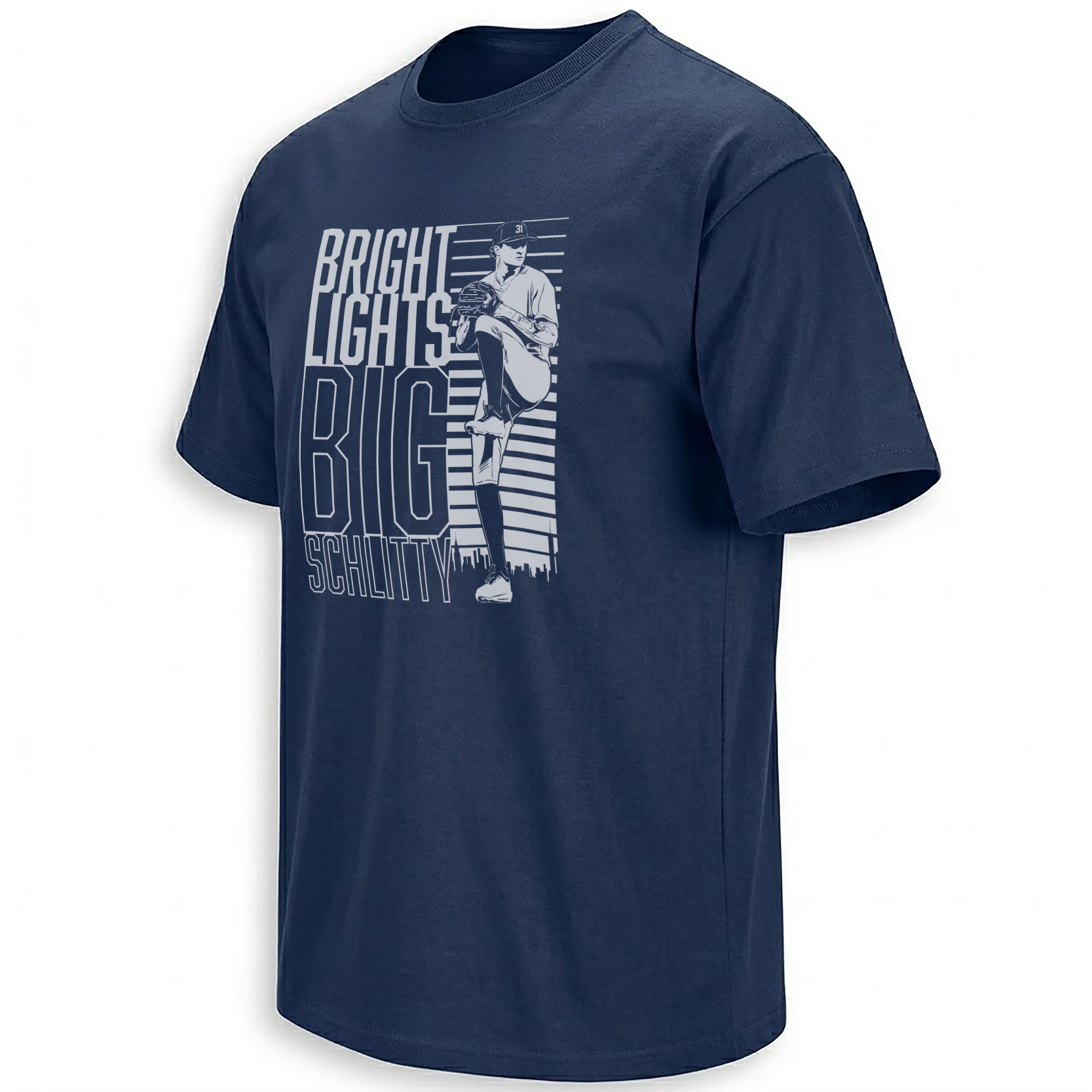
Bright Lights, Big Schlitty uses the visual language of New York entertainment rather than a conventional pitching poster.
The title echoes the cadence of a city story: bright lights, large personality and the sense that ordinary scale is unavailable. Placing “Big Schlitty” at the center turns the nickname into the featured attraction.
Pink, red and electric blue create the feeling of neon reflecting through a night street. These are not the restrained colors of a box score or vintage baseball card. They belong to marquees, theater districts and the glowing commercial language associated with New York after dark.
Schlittler’s figure anchors the composition inside baseball while the surrounding color enlarges the setting. The artwork is not claiming that a pitcher has become an actor. It is showing how New York converts performance into spectacle.
The nickname lettering carries the greatest visual weight because the cultural story is no longer limited to one statistic. “Schlitty” can describe the player, a dominant start or the mood spreading through the stadium when the strikeout count begins climbing.
Unlike the friendlier “Hello Schlitty” language, this composition presents him after the introduction. New York already knows who has taken the mound. The lights are on because the show has started.
The Design Captures a Different Part of the Schlitty Vocabulary
Fan nicknames become culturally useful when they can change tone without losing their subject.
“Hello Schlitty” operates as an introduction. It reflects the first stage of recognition, when fans begin welcoming a young player into the larger Yankees conversation.
“Schlitty Good” functions as a review. It is the compact verdict delivered after another strong outing.
“Bright Lights, Big Schlitty” expands the scale. It places Schlittler inside New York mythology, where important performers are expected to succeed while the entire city is watching.
The progression mirrors his career. He arrived in July 2025 as an emergency solution after an injury created an opening. He left October as a rivalry hero. By June 2026, he was being discussed as an All-Star starter and Cy Young candidate.
The nickname is growing because the player’s stage is growing.
The 13-Strikeout Night Changed the All-Star Conversation
Before the Cincinnati start, Schlittler was already assembling one of the strongest first halves among American League pitchers. The career-high performance made the case more difficult to treat as a temporary early-season story.
His 1.71 ERA through sixteen starts was the lowest by a Yankee at that stage since Whitey Ford posted a 1.47 mark in 1964. He had 109 strikeouts in 95 innings, an 8–3 record and a 0.89 WHIP.
The historical comparison does not require predicting that Schlittler will reproduce Ford’s career. Its value is contextual: young Yankees pitchers rarely begin a season with this combination of run prevention, strikeouts and sustained control.
Jazz Chisholm Jr. argued that Schlittler should start the All-Star Game. Knicks champion Josh Hart described him as his clear Cy Young choice. The crossover between baseball and basketball showed how far the story had moved beyond pitching analysis.
Schlittler’s public response remained more restrained than the endorsements. He emphasized consistency, health and helping the Yankees win rather than accepting an award campaign in June.
That difference strengthens the bright-lights identity. The city can continue enlarging the story while the pitcher keeps reducing it to the next start.
New York Rewards Calm Differently Than Other Markets
The stereotype of New York sports culture emphasizes volume: loud crowds, sharp criticism, constant media attention and little patience for visible uncertainty.
Inside that environment, calm becomes its own form of charisma.
Schlittler does not need to display theatrical intensity after every strikeout because the velocity already provides drama. His stillness between pitches gives the crowd room to supply the emotion around him.
This dynamic has shaped several enduring New York pitching identities. The city often attaches deeply to players who appear capable of making an enormous moment smaller without making it feel less important.
Schlittler remains early in that process. Sixteen starts do not establish a finished legacy, and every young pitcher must manage adjustment, workload and health over multiple seasons.
Yet the first evidence is unusually clear. The larger the game has felt, the more controlled his body language has become.
From Seventh-Round Pick to Featured Attraction
Bright-lights language can make Schlittler’s rise sound inevitable. His development path was anything but.
The Yankees selected him in the seventh round of the 2022 MLB Draft after his career at Northeastern. He was the 220th overall selection, one of hundreds of players entering professional baseball without certainty that a major-league role would exist.
He advanced through the system by turning physical projection into usable pitching. Velocity increased, the fastball became a defining weapon and secondary shapes developed enough to prevent hitters from reducing every at-bat to one pitch.
His 2025 season began outside the major-league rotation. Injuries created the opportunity, but opportunity alone could not produce a 2.96 rookie ERA or the historic Wild Card performance against Boston.
The contrast between draft position and current stage adds meaning to the artwork. “Big Schlitty” was not introduced as a national celebrity. New York’s largest baseball platform has been reached through development, necessity and repeated execution.
The Bronx Has Begun Treating His Starts Like Events
A starting pitcher becomes culturally important when fans begin organizing attention around his day.
At first, supporters follow the team schedule. Later, they identify the matchup. Eventually, one pitcher’s name changes the emotional expectation before the game begins.
Schlittler is entering that third stage. “Cam Day” and “Schlitty Day” now carry meaning because the audience expects velocity, strikeouts and at least one sequence that makes a hitter appear physically late.
That expectation is not a guarantee of dominance. Starting pitching remains vulnerable to small command errors, defensive outcomes and the adjustments opponents build from previous meetings.
Event status does not mean every performance will become historic. It means fans believe history is possible enough to watch from the first inning.
The 13-strikeout night rewarded that attention. More than 42,000 people arrived for a June game and left having participated in the largest strikeout performance of Schlittler’s major-league career.
A New York Graphic Built Around Scale
The most important word in the title may be “big.”
New York constantly enlarges performance. A strong game becomes a headline. A rivalry start becomes a character test. An emerging pitcher becomes an All-Star and Cy Young argument before the season reaches July.
Bright Lights, Big Schlitty does not resist that enlargement. It turns it into the visual concept.
The oversized nickname, vivid color and nighttime atmosphere present Schlittler as a figure who can occupy the scale of the city without being visually lost inside it.
The design remains playful because “Big Schlitty” sounds deliberately less formal than the achievements surrounding it. That humor protects the artwork from becoming an overly serious award campaign.
Fans can celebrate elite performance while still speaking in the nickname language that made the player feel accessible in the first place.
The Current Yankees Story Is Becoming Homegrown
The Yankees will always be associated with stars acquired from outside the organization. Their financial scale and championship expectations make major additions part of the franchise identity.
Schlittler’s rise adds a different layer. He reached New York through the Yankees’ own development system, as did Ben Rice, whose three-run homer supplied much of the offense during the Cincinnati shutout.
Seeing Schlittler dominate while Rice drives in runs creates a version of Yankees success built from draft evaluation and development rather than only external acquisition.
That matters to fans because homegrown players allow the audience to follow more of the journey. Scranton, Somerset and Hudson Valley become part of the major-league story rather than separate minor-league locations.
The wider New York Yankees collection preserves that current era through player nicknames, rivalry moments and the emerging identities shaping the Bronx lineup and rotation.
The broader MLB Shirts and Apparel archive follows the same process across baseball, where a prospect can become a citywide character before the season has finished defining his ceiling.
Why This Is Not the Same Story as Hello Schlitty
The first stage of a breakout is discovery. The second is expectation.
“Hello Schlitty” belongs to discovery. It welcomes the nickname, introduces the player and captures the lightness of a young pitcher becoming recognizable.
Bright Lights, Big Schlitty belongs to expectation. It asks what happens when the introduction is complete and the city begins treating every major start as proof of something larger.
That shift creates pressure. Schlittler is no longer surprising opponents simply by possessing elite velocity. Scouting reports are deeper, hitters are adjusting and every difficult outing will be examined against the standard he has created.
The bright lights are therefore not only celebratory. They are investigative. They reveal whether the performance can remain stable while attention intensifies.
Schlittler’s answer through mid-June has been unusually convincing.
What Comes After the Marquee
Baseball does not allow one dominant month to become a completed story. Schlittler must still navigate the innings of his first full major-league season, repeated opponents and the normal physical demands placed on a high-velocity starter.
His cutter, sinker and breaking pitches will remain important as hitters build plans around the elevated four-seamer. Command will determine whether high strikeout totals arrive efficiently enough for him to work deeper into games.
Awards will depend on months that have not yet been played. The All-Star and Cy Young conversations are measures of his current standing, not guarantees of the final vote.
Cultural identity, however, often forms before the final statistics are complete. Fans do not wait for a career retrospective before deciding which phrases belong to a player.
New York has already developed several for Schlittler. This one captures the largest version.
The lights are bright. The stage is enormous. Big Schlitty keeps throwing strikes.
Frequently Asked Questions
What does “Bright Lights, Big Schlitty” mean?
The phrase describes Cam Schlittler’s ability to deliver strong performances during highly visible New York moments, including the Yankees–Red Sox postseason rivalry, his Subway Series debut and major starts at Yankee Stadium.
What did Cam Schlittler do against Cincinnati on June 19, 2026?
Schlittler recorded a career-high 13 strikeouts over six scoreless innings, allowed four hits and issued no walks during the Yankees’ 5–0 victory.
How did Schlittler perform in his first Subway Series start?
He struck out nine batters as the Yankees defeated the Mets 5–2 at Citi Field on May 15, 2026.
Why is Schlittler considered a big-game pitcher?
His reputation began with eight scoreless innings and 12 strikeouts in the deciding game of the 2025 Wild Card Series against Boston, then grew through strong performances in other high-attention New York matchups.
What pitches make Cam Schlittler difficult to hit?
Schlittler combines a high-velocity four-seam fastball with a sinker and cutter that can begin from similar release points but finish in different parts of the strike zone.
What does the Bright Lights, Big Schlitty artwork represent?
The design places Schlittler inside a colorful New York nighttime setting, using neon-style pink, blue and red lettering to portray him as the featured attraction under the city’s brightest baseball lights.
The Bright Lights, Big Schlitty design preserves Cam Schlittler’s rise as a New York big-game pitcher, while the wider Yankees visual archive follows the homegrown players, rivalry performances and Bronx language defining the current season.
Bright Lights, Big Schlitty Shirt celebrates Cam Schlittler’s rise under New York’s biggest baseball spotlight through vivid neon-style lettering, colorful city-night energy and the nickname defining his dominant Yankees breakout.