
Jerks on Parade: Carolina Turned an Old Insult Into a Stanley Cup Victory Lap
Seven years after the Hurricanes were mocked for celebrating too loudly, the “Bunch of Jerks” finally received the largest celebration of all: a Stanley Cup, an open-top parade and a downtown Raleigh crowd that transformed an old insult into civic identity.
On June 20, downtown Raleigh became the physical version of a Hurricanes inside joke. Red jerseys filled the streets, players leaned over open-top vehicles, the Stanley Cup moved through the city and approximately 150,000 people gathered to celebrate Carolina’s first championship in twenty years.
The scale of the scene mattered because this franchise had once been criticized for the simple act of making hockey look joyful. In 2019, the Hurricanes’ elaborate postgame Storm Surge celebrations were dismissed by commentator Don Cherry, who called the players a “bunch of jerks.”
Carolina did not retreat from the phrase. The team printed it, supporters wore it and Caniacs converted the attempted insult into a statement about refusing to perform hockey respectability for outsiders.
Seven years later, those jerks were riding through Raleigh with the Stanley Cup. “Jerks on Parade” was no longer merely a clever combination of two ideas. It was the literal ending to one of the most recognizable identity stories in modern hockey culture.
The same team once criticized for celebrating after wins eventually received an entire city as its celebration stage.
From Storm Surge to Stanley Cup paradeThe Insult That Carolina Refused to Treat Like an Insult
The original “Bunch of Jerks” moment belongs to a specific period in Hurricanes history. During the 2018–19 season, Carolina began staging increasingly theatrical postgame celebrations after home victories.
The Storm Surge could involve bowling pins, basketball nets, human dominoes or players pretending to participate in another sport. It was deliberately excessive, designed to reward the home crowd after the formal hockey work had ended.
Traditionalists viewed those scenes as unserious. To Carolina supporters, that criticism misunderstood the purpose. The Hurricanes were not mocking opponents or replacing competition with performance. They were creating a shared ritual in a market that had spent years being told it did not fit hockey’s conventional geography.
When Cherry used the word “jerks,” the phrase contained exactly the opposition Carolina needed. It framed the Hurricanes as young, loud and disrespectful of an older hockey code. The team’s response was to accept every part of that description except the shame.
“Bunch of Jerks” became powerful because it allowed fans to say that Carolina would build hockey culture according to its own personality rather than wait for approval from elsewhere.
Don Cherry condemned Carolina’s Storm Surge celebrations and supplied the phrase the franchise would later make its own.
Players, supporters and team culture turned “Bunch of Jerks” into a declaration of humor, defiance and Southern hockey confidence.
Winning the Stanley Cup gave the nickname its perfect public ending: the jerks were no longer celebrating one home win, but an entire championship.
Why the Parade Completed the Storm Surge Story
The Storm Surge was always a miniature parade. Players gathered after a victory, performed for the stands and converted the final horn into something communal rather than private.
The 2026 Stanley Cup celebration expanded the same logic from an arena to a city. Instead of circling the ice, Carolina moved through downtown Raleigh. Instead of one section waiting for the next joke, miles of supporters lined the route.
The connection is not purely visual. Both events were arguments about who gets to define legitimate hockey celebration.
In 2019, critics wanted the Hurricanes to win, salute the crowd and leave the ice. In 2026, the team had earned the right to stop traffic, carry the Cup through the state capital and invite North Carolina into the celebration.
A victory parade is culturally protected excess. Noise, costumes, open containers, improvised speeches and public disorder become acceptable because the championship has authorized them.
Carolina’s journey is therefore unusually satisfying. The franchise was criticized for excessive celebration before it had won anything. It eventually won the most important trophy in hockey and celebrated on a scale nobody could dismiss as premature.
The downtown route transformed Raleigh into a moving Hurricanes archive. Players, the Stanley Cup and generations of Caniacs passed through the city together, giving the “Jerks on Parade” phrase a real map rather than an imagined setting.
Raleigh’s Crowd Was the Answer to an Older Hockey Argument
Carolina’s championship carried a debate that extended beyond the roster. For decades, teams in nontraditional markets have been required to prove their hockey legitimacy repeatedly.
Strong attendance can be treated as temporary. Playoff noise can be described as novelty. Regional identity can be questioned because it does not resemble the sport’s older Canadian and northern American traditions.
The Raleigh parade made those arguments difficult to sustain. Approximately 150,000 people crowded downtown, with supporters arriving early enough to fill the route and City Plaza long before the players reached the rally.
That crowd represented more than current success. It contained supporters who remembered the 2006 championship, fans who entered the culture during the Storm Surge era and children for whom the Hurricanes have always been part of North Carolina’s sports landscape.
On the rally stage, Governor Josh Stein directly revived the “Bunch of Jerks” history while rejecting the idea that Raleigh was too small to function as a hockey city. The crowd response showed that the old criticism had become useful only as material for celebration.
The Artwork Makes the Bus the Main Character
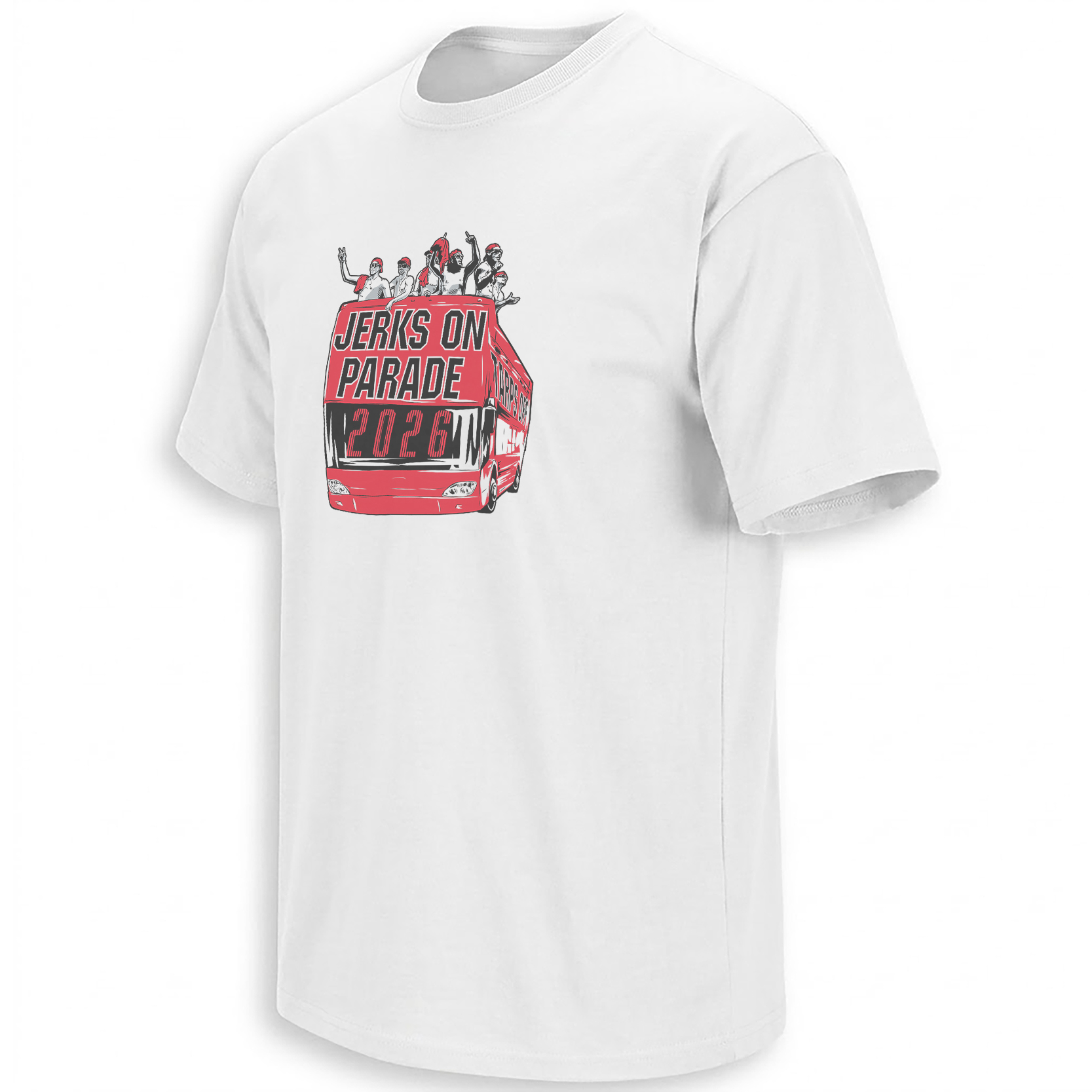
Most championship graphics rely on a familiar hierarchy: trophy, team name, year and formal title language. Jerks on Parade chooses movement instead.
The red double-decker bus dominates the composition, facing slightly toward the viewer as though it is arriving rather than sitting inside a commemorative frame. The perspective gives the illustration direction and makes the white shirt base feel like open road.
“Jerks on Parade” is positioned across the upper front of the bus in tall, condensed lettering. The words resemble a destination sign, a concert-poster title and a hand-painted parade banner simultaneously.
The windshield carries “2026” in oversized red numerals against a dark black field. That placement makes the year feel like the bus route itself: everything in the image is travelling toward the championship season.
Above the vehicle, illustrated players raise hands, point toward the crowd and occupy the roof with deliberately uneven energy. Their sketch-like rendering prevents the design from looking like a formal roster photograph. They read as a collective celebration rather than a lineup requiring individual identification.
The limited red, black, white and grey palette gives the artwork the feeling of an event poster printed quickly after the final horn. It is polished enough to preserve the scene but loose enough to retain parade chaos.
The vehicle creates forward motion, the condensed headline carries street-sign urgency and the sketch-style figures preserve the joyful disorder of a championship roster finally released from playoff structure.
The Word “Jerks” Means Something Different in Carolina
Outside Hurricanes culture, “jerk” remains a simple insult. Inside it, the word has acquired a set of specific associations.
It means refusing to apologize for the Storm Surge. It means accepting that traditional hockey audiences may never fully understand Raleigh’s version of the sport. It means turning criticism into merchandise, arena chants and shared community language before the critic can control the meaning.
Most importantly, it means belonging. A fan who identifies with the “Bunch of Jerks” is not claiming bad behavior. The phrase signals recognition of the Hurricanes’ modern cultural turning point.
The nickname emerged during the season Carolina returned to the playoffs after a long drought. That timing gave it emotional permanence. The Storm Surge, the 2019 postseason breakthrough and the reclamation of “jerks” all became part of the same reawakening.
By 2026, the word no longer needed explanation inside the fan base. It had become a compact history lesson.
Winning Changed the Meaning Without Erasing the Joke
Sports identities often lose some of their charm when success becomes official. Underdog language can feel less convincing after a team reaches the top.
“Bunch of Jerks” survived the championship because it was never based only on losing, disrespect or external doubt. It was based on personality.
Carolina could win the Cup without becoming quieter. The team could accept the formal championship ceremony while still producing chaotic rally speeches, shirtless appearances, sirens and improvised celebration.
The parade therefore did not retire the nickname. It promoted it. “Jerks” could now describe a championship roster rather than an entertaining group trying to earn recognition.
That distinction gives the phrase lasting value. The 2026 title did not prove critics wrong by making Carolina resemble a traditional hockey power. It proved that the Hurricanes could reach hockey’s highest point while remaining culturally recognizable.
The Parade Was Joyfully Less Controlled Than the Playoffs
The contrast between playoff hockey and a championship parade is extreme. For two months, players operate inside narrow routines. Shifts are timed, matchups are planned, interviews are managed and emotional control is treated as competitive discipline.
The parade removes nearly all of that structure. Players can interrupt speeches, carry drinks, lean toward supporters and react to the city without needing to prepare for another game.
Carolina’s celebration reflected that release. Rod Brind’Amour addressed the crowd as both the coach of the 2026 champions and the captain who had lifted the Cup in 2006. Jordan Staal raised the trophy as captain and playoff MVP. Seth Jarvis supplied an unfiltered championship declaration.
Nicolas Deslauriers announced a two-year extension from the stage in language suited to the day, while the Storm Surge mentality escaped the arena and took over the rally.
“Jerks on Parade” captures that freedom better than a formal phrase such as “championship procession.” It sounds like something Caniacs would say to each other while watching the bus approach.
From a Small-Market Punchline to a Statewide Identity
The Hurricanes occupy an unusual place within North Carolina sports. College loyalties divide the region among North Carolina, NC State, Duke and other programs with generations of history.
The Hurricanes can briefly reorganize those divisions. During the Stanley Cup run, Raleigh, Cary, Durham and communities throughout the state shared one schedule, one siren and one postseason anxiety.
The parade made that collective identity visible. The crowd was not only a collection of regular-season ticket holders. It included casual supporters, families, long-distance travellers and people drawn toward the scale of a rare public event.
That is how sports cultures become civic rather than merely commercial. The team creates a memory that can be located on actual streets.
Future Raleigh residents may not remember every goal in the Final, but the image of a red championship bus moving through downtown will remain understandable. It is the visual proof that the Hurricanes once caused the city to stop functioning normally.
Why the Bus Is a Better Symbol Than Another Trophy Graphic
The Stanley Cup remains the essential object of the championship, but trophy imagery tells only one part of the story. It establishes what Carolina won, not how the community received it.
The bus introduces public participation. A trophy can be lifted inside an arena. A parade vehicle requires a route, a crowd and a city willing to surrender its streets.
That difference gives the Jerks on Parade design a documentary quality. The bus represents the movement of the championship from the team’s private possession into shared Raleigh memory.
Players stand above the vehicle because the parade reverses the usual relationship between athletes and spectators. During games, supporters look down toward the ice. On the street, the team rises above the crowd and travels slowly enough for every block to participate.
The illustration preserves that reversal. The championship roster is elevated, but it remains accessible, waving and reacting rather than posing behind a formal title mark.
A Cultural Timeline That Took Seven Years to Complete
The distance between 2019 and 2026 gives the design more depth than an ordinary parade slogan.
In 2019, Carolina was trying to reintroduce itself to the hockey world. The Storm Surge made the team visible, “Bunch of Jerks” gave supporters a shared identity and the playoff return established that the entertainment was attached to serious competition.
The following seasons transformed the Hurricanes into a consistent contender. Each postseason brought more belief and more frustration. Carolina could win rounds, control play and produce strong regular seasons, but the Stanley Cup remained beyond reach.
The 2026 victory completed both the competitive and cultural projects. The Hurricanes had become champions, and they had done so without abandoning the personality that helped revive the franchise.
The parade allowed all those eras to appear at once. Older “Bunch of Jerks” pieces stood beside new championship graphics. Storm Surge memories returned inside a celebration now protected by the Cup.
The bus was carrying more than one roster. It was carrying seven years of fan language.
The Joke Now Belongs to Championship History
Reclaimed insults usually depend on continued opposition. The targeted group repeats the language to remove power from the person who used it.
Carolina’s version has moved beyond that stage. “Bunch of Jerks” no longer requires Don Cherry’s original criticism to remain meaningful. Newer fans can understand the phrase through the community that inherited it.
The Stanley Cup gives the nickname a permanent historical anchor. Future references to the “jerks” can lead naturally to the 2026 champions, the parade and the generation of Hurricanes hockey that changed Raleigh’s relationship with the sport.
This is why the phrase works especially well in collectible visual culture. It records both the joke and its outcome.
The design does not claim that Carolina won because it was criticized in 2019. It shows that the identity born from that criticism survived long enough to participate in the victory.
Carolina’s Championship Archive Has Room for Chaos
A championship is too large to be remembered through one official logo. Fans preserve it through different emotional categories.
Trophy-lift graphics document the result. Player pieces preserve individual goals and personalities. Parade quotes capture the release after the competition. Jerks on Parade records the fan identity that connected the entire modern era.
The wider Carolina Hurricanes collection now operates as a running visual archive of those layers: Storm Surge history, player nicknames, Stanley Cup moments and the Raleigh celebration that carried everything into the streets.
The broader NHL Shirts collection places those Carolina images inside hockey’s larger culture, where chants, regional identities, rivalry language and unusual celebrations can become as memorable as official statistics.
Jerks on Parade belongs in both archives because it explains something specific about this championship. Carolina did not only win the Cup. It brought the personality of the Storm Surge era with it.
Why “Jerks on Parade” Is the Perfect Final Line
The phrase works because every word carries history.
“Jerks” returns to the criticism Carolina claimed as its own. “Parade” names the public reward waiting at the end of the championship run.
Together, they produce a sentence that could not have been fully understood in 2019. The Hurricanes had the nickname then, but not yet the reason to shut down downtown Raleigh.
By June 2026, the phrase no longer required imagination. The bus existed. The Cup was aboard. The streets were full.
The same fan base once told that its team celebrated too much finally received a day when too much celebration was impossible.
The jerks got their parade.
Frequently Asked Questions
Why are the Carolina Hurricanes called a “Bunch of Jerks”?
The phrase began in 2019 after commentator Don Cherry criticized Carolina’s theatrical Storm Surge postgame celebrations and called the players a “bunch of jerks.” The team and its supporters embraced the insult and turned it into a fan identity.
What were the Carolina Hurricanes’ Storm Surge celebrations?
The Storm Surge was a series of creative postgame performances staged after home victories. Players used props, acted out other sports and created theatrical scenes for the crowd at PNC Arena.
When was Carolina’s 2026 Stanley Cup parade?
The Hurricanes held their championship parade and rally in downtown Raleigh on June 20, 2026, six days after clinching the Stanley Cup.
How many people attended the Hurricanes’ championship parade?
Contemporary reports and city estimates placed attendance at approximately 150,000 people along the downtown Raleigh route and near the rally stage.
What does “Jerks on Parade” mean?
The phrase combines Carolina’s long-running “Bunch of Jerks” identity with the real victory parade that followed the team’s 2026 Stanley Cup championship.
What does the Jerks on Parade artwork show?
The design shows a red open-top championship bus carrying cheering hockey figures, with “Jerks on Parade” across the front and 2026 displayed prominently in the windshield.
The Jerks on Parade design connects Carolina’s Storm Surge identity with the red victory bus that carried the Cup through Raleigh, while the wider Hurricanes championship archive follows the personalities, slogans and fan memories behind the 2026 title.
Jerks on Parade Shirt connects the Carolina Hurricanes’ iconic “Bunch of Jerks” identity with their 2026 Stanley Cup celebration through a red open-top parade bus, cheering players and bold championship-year artwork.