
Skenes Limit 100 How the radar gun became part of Pittsburgh’s baseball language
Paul Skenes entered the final week of June with a 2.86 ERA, 107 strikeouts and one of the National League’s lowest WHIPs. Yet the clearest symbol of his Pittsburgh presence remains simpler than any stat line: three digits glowing on a radar display.
Every Paul Skenes start produces two simultaneous broadcasts. One is the baseball game itself: count, score, runners, innings and the tactical work of navigating a major-league lineup. The other is smaller, faster and almost impossible to ignore—the velocity reading that appears immediately after the pitch reaches the catcher.
That second broadcast has shaped how Pittsburgh watches its ace. A fastball at 97 mph is evaluated as a pitch. A fastball touching 100 becomes an event, a number that can travel through the ballpark before the replay has finished. Fans see it on the scoreboard, hear the crowd react and understand instantly that the physical scale of the at-bat has changed.
The current conversation around Skenes is more complicated than simple velocity worship. Through June 22, the Pirates had lost seven consecutive games started by him, even though he continued to rank among the National League leaders in ERA, WHIP, opponent batting average and strikeouts. His four-seam velocity had eased from the extraordinary level of his first two seasons, but the broader pitching profile remained elite enough to expose how unrealistic the expectations around him had become.
That tension is what makes “Skenes Limit 100” feel current rather than nostalgic. The phrase references the spectacular number that introduced him to much of baseball while leaving room for the pitcher he has continued to become: less dependent on one reading, deeper in pitch selection and increasingly judged against a standard that almost no starter could satisfy.
With Skenes, the radar gun does not merely measure the pitch. It becomes part of the atmosphere before the hitter has decided whether to swing.
The spectacle inside every startThe Number Appears Before the Story Is Finished
Pitch velocity is one of baseball’s most efficient forms of information. A fan does not need to study release angle, vertical movement or run value to understand that 100 mph represents an unusual physical threshold. The number communicates danger before analysis begins.
That is why triple-digit pitching became central to Skenes’ public identity so quickly. The first overall selection in the 2023 MLB Draft arrived with the mechanics, size and power associated with a prototype ace. When he reached Pittsburgh in May 2024, the radar reading gave the excitement an easily shared visual language.
A 100-mph pitch can be clipped into a highlight, placed in a social caption or converted into a stadium graphic without context. It does not require an entire inning to understand. The number carries its own drama: the hitter has roughly four-tenths of a second to recognize the pitch, decide and move the bat through the zone.
Yet velocity alone never explained why Skenes separated himself from other hard throwers. Major-league hitters can prepare for speed when they know where it is going and what shape it will take. Skenes combined that power with command, angle and a pitch mix capable of moving in several directions from a similar release.
Why “Limit 100” Reverses the Logic of a Road Sign
A normal speed-limit sign is built to restrict. It tells drivers that reaching the printed number would mean approaching the boundary of acceptable movement. The Skenes version turns that instruction backward.
Here, 100 is not presented as a number to avoid. It becomes the expected territory surrounding the pitcher. The warning is directed less toward the person creating the speed than toward the hitter standing sixty feet and six inches away.
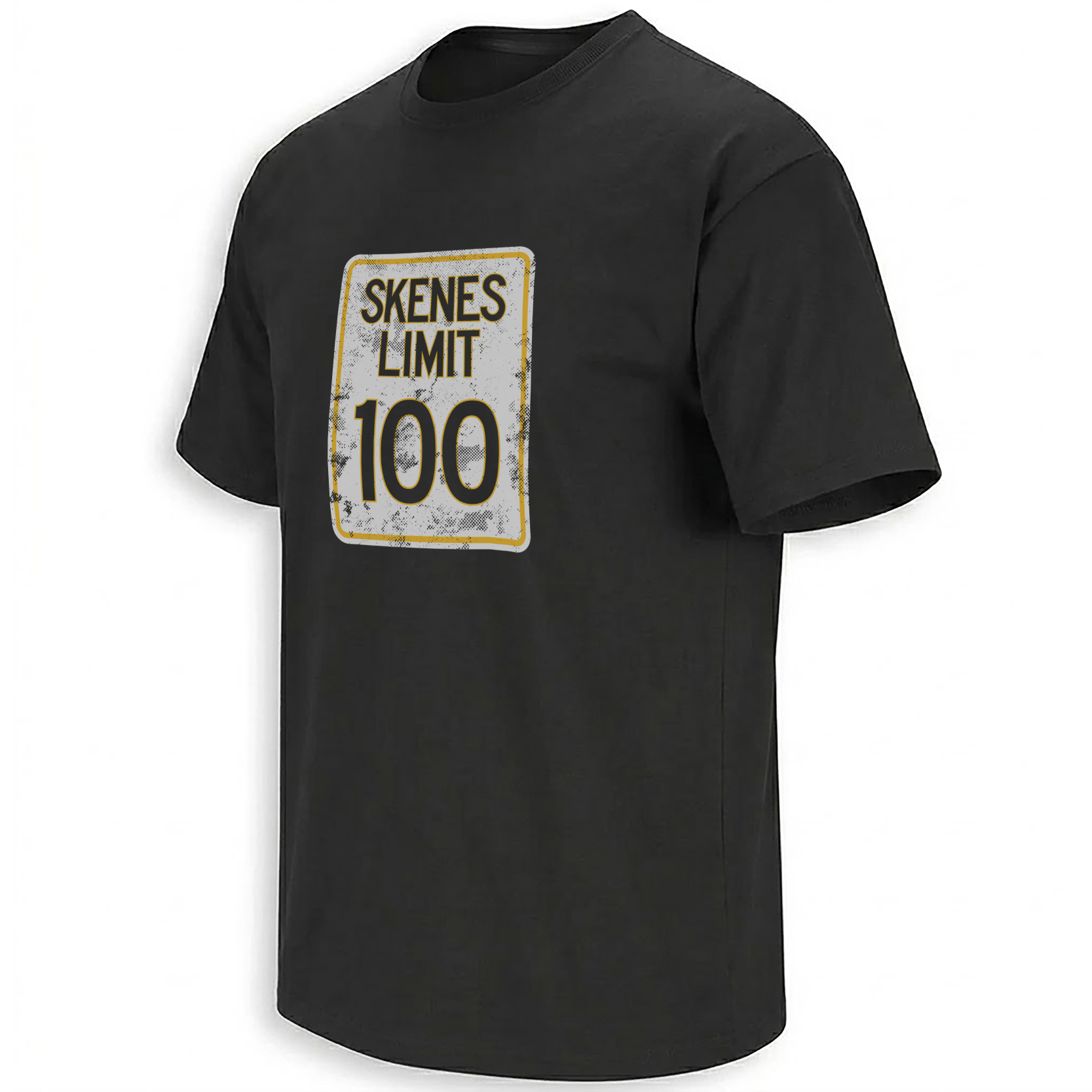
That reversal gives the phrase its humor. “Skenes Limit 100” looks official enough to be understood immediately, but the joke becomes clear as soon as the viewer recognizes the surname. The sign is not managing traffic. It is describing what happens when one of baseball’s most recognizable power pitchers takes the mound.
The design also benefits from avoiding a literal action portrait. No pitching pose is needed. No baseball trail or explosive visual effect is necessary. The traffic symbol already contains movement, risk, regulation and anticipation. Replacing “Speed” with “Skenes” completes the connection.
One Hundred Is a Symbol, Not a Literal Scouting Report
The strongest interpretation of the graphic requires an important distinction: “100” represents the mythology around Skenes’ velocity, not a claim that every fastball reaches exactly that speed.
His four-seam fastball has averaged closer to 97 mph in 2026, down from the upper-98 range that defined his arrival. That decrease has become part of the public debate around his season, especially during a run in which opponents have extended at-bats and forced him into higher pitch counts.
The reaction reveals how quickly exceptional performance can become a baseline. A starting pitcher averaging 97 mph would still be described as a power arm in almost any other context. With Skenes, the same reading is sometimes treated as evidence that something is missing because audiences became accustomed to seeing a more extreme version.
His results still complicate that concern. Even after a difficult seven-start stretch, Skenes remained among the National League leaders with a 2.86 ERA, a 0.93 WHIP, a .199 opponent batting average and 107 strikeouts through 88 innings. Those numbers describe an effective starter even when the presentation looks less overwhelming than it did at the beginning.
“Skenes Limit 100” works as fan shorthand for the triple-digit threat associated with his rise. It should not be read as a claim that every pitch—or even every fastball—is currently thrown at precisely 100 mph.
The 2026 Season Has Tested the Difference Between Dominance and Expectation
Skenes began 2026 from a nearly impossible position. He was no longer simply the most exciting young pitcher in Pittsburgh. He entered the season as the reigning National League Cy Young Award winner after posting a 1.97 ERA with 216 strikeouts in 2025.
He had moved from prospect to ace so quickly that ordinary pitching fluctuation became difficult to discuss normally. A solid start could feel disappointing if it lacked a no-hit bid. Allowing two runs could become evidence of decline. A fastball sitting at 97 rather than approaching 100 could dominate the conversation even when the complete outing remained effective.
Opening Day intensified that scrutiny. Skenes recorded only two outs against the Mets and was charged with five earned runs during the shortest start of his major-league career. Pittsburgh’s defense contributed to the damage, but the image of the reigning Cy Young winner leaving in the first inning immediately disrupted the assumption that 2026 would simply continue the previous season’s pattern.
He responded with stretches that looked much closer to the pitcher fans expected. In May, he worked eight scoreless innings against Colorado, struck out ten and carried a no-hit bid into the seventh. In another eight-inning start, he struck out the side to finish his night and lowered his ERA to 2.36.
The more recent results have been harder to process. The Pirates lost seven consecutive Skenes starts through June 20. During much of that stretch, he allowed relatively few runs but received limited offensive support, while opposing hitters extended plate appearances and forced him beyond 100 pitches repeatedly.
That is where the phrase “limit” gains an unintended second meaning. The central 100 can refer to radar-gun spectacle, but it can also recall the workload threshold that now shapes many modern starts. Fans watch whether a fastball reaches 100 mph and, later, whether the total pitch count reaches 100 before the seventh inning is complete.
Modern Hitters Are Trying to Survive the At-Bat Before Winning It
The challenge of facing Skenes has changed as the league has accumulated more information. Early in a pitcher’s career, hitters are often reacting to unfamiliar movement and velocity. Over time, opponents begin designing collective approaches around what they can control.
Against Skenes, that can mean turning the plate appearance into an endurance exercise. Hitters protect earlier, foul off difficult pitches and resist the temptation to end the at-bat with one aggressive swing. The immediate goal may be less about producing a hit than about making him throw a sixth or seventh pitch.
This strategy attacks the structure around the ace rather than the ace himself. Even when hitters do not score, they can shorten his outing and force the game toward Pittsburgh’s bullpen. The confrontation becomes a contest between pitch quality and accumulated resistance.
Skenes has thrown at least 103 pitches in several recent starts, a sign of how relentlessly lineups have attempted to stretch his workload. Strikeout pitchers naturally use additional pitches because finishing an at-bat often requires reaching two strikes and then finding the final swing. When hitters repeatedly spoil those finishing pitches, the count rises even when the scoreboard remains controlled.
In that environment, the most important form of velocity is not always the highest single number. It is usable speed: the ability to preserve enough command and pitch quality to keep attacking when the total count moves into triple digits.
The most visible pitch in the arsenal supplies the clean radar reading and forces hitters to make decisions at the top edge of reaction time.
Movement prevents hitters from preparing only for straight velocity, creating late uncertainty even when the pitches leave the hand from similar lanes.
Once ahead, Skenes can change shape and speed, making the finishing pitch harder to predict than the radar-gun headline suggests.
Opposing hitters increasingly try to extend plate appearances, foul off quality pitches and make the ace spend more of his workload on every out.
Pittsburgh Fans Are Watching the Ace and the Team Around Him
The debate around Skenes cannot be separated from the Pirates’ results. Pitchers are officially assigned wins and losses, but the outcome of a start depends on run support, defense and the bullpen after the starter leaves.
On June 20 at Colorado, Skenes allowed two runs across six innings and struck out eight. Pittsburgh lost 2–1. It was another quality start attached to a team defeat, extending a pattern that made the record look harsher than the performance itself.
That imbalance has shaped fan frustration. Some discussion has focused on the slight velocity reduction or his difficulty during a third trip through the lineup. Just as much attention has fallen on an offense that frequently fails to create a margin and a roster that can make a well-pitched game feel fragile.
The emotional structure of a Skenes start is therefore unusual. Fans arrive expecting to see one of baseball’s most compelling pitchers, but the excitement carries anxiety. Every scoreless inning feels valuable because the Pirates may not provide many runs. Every rising pitch count feels threatening because removing Skenes can expose the next part of the game.
The radar gun remains the cleanest part of that experience. Team-building questions are complicated. Run support is unpredictable. A triple-digit fastball provides immediate certainty: for one pitch, Pittsburgh controls the physical scale of the game.
Why the Distressed Sign Fits Pittsburgh Better Than a Polished Graphic
A perfectly clean road sign would communicate the joke, but the weathering gives the design cultural texture. Scratches, faded patches and scuffed edges make the graphic appear as though it has existed near the ballpark long enough to become local infrastructure.
That worn surface also fits Pittsburgh’s visual language. Black and gold carry across the city’s major sports identities, while industrial materials, bridges, steel and concrete remain part of its familiar graphic vocabulary. The design does not need to reproduce a skyline to feel regional.
The rectangular composition is rigid and highly legible. “Skenes” occupies the top line where a driver would expect to see the word “Speed.” “Limit” confirms the format. The oversized 100 dominates the lower half, mirroring the hierarchy of an actual roadside marker.
A muted gold outline around the letters and numerals prevents the black typography from feeling detached from Pirates culture. The color is controlled rather than decorative. It acts like reflective sign paint—visible around the edges and strongest where the eye needs guidance.
The absence of a player portrait is especially effective. Skenes’ face, uniform number and pitching motion are not necessary because his surname and the number 100 already form a complete cultural association. The graphic trusts recognition rather than forcing it.
From Radar Reading to Baseball Identity
The relationship between pitchers and velocity has changed dramatically in the Statcast era. Fans can now follow release speed, spin, movement, extension and pitch location in real time. Information once reserved for scouts and team analysts has become part of the ordinary viewing experience.
Skenes arrived at the ideal moment for that kind of attention. His physical tools produced measurements dramatic enough to be understood by casual fans, while his deeper arsenal rewarded more technical analysis. A viewer could celebrate 100 mph without knowing anything else, then discover why the next 92-mph pitch was equally difficult to hit.
This dual appeal helped turn him into a national baseball figure almost immediately. He was the first overall draft pick, a central figure in LSU’s 2023 championship, the 2024 National League Rookie of the Year and the 2025 Cy Young winner. By 2026, his starts no longer felt like the introduction of a prospect. They felt like scheduled baseball events.
The broader Pittsburgh Pirates collection reflects how that event culture becomes visual language—from player nicknames and pitching references to city-specific black-and-gold humor. The wider MLB Shirts collection follows the same process across baseball, where individual pitches, statistical milestones and broadcast graphics become symbols fans can recognize beyond a single game.
Why 100 Still Matters When the Pitch Is 97
Sports symbols rarely operate as precise averages. A home-run slogan does not require a player to homer in every game. A strikeout graphic does not suggest every batter will miss. “100” works the same way.
It represents capability, threat and memory. The hitter knows Skenes can reach that territory. The fan remembers the early starts when the radar display repeatedly entered triple digits. The number remains inside the at-bat even when the specific pitch is slightly slower.
In some ways, a 97-mph fastball can become more effective when the arsenal around it expands. Hitters who must protect against a changeup, splinker, sinker or breaking pitch cannot simply time the hardest offering. The difference between pitches creates the disruption.
Skenes has publicly emphasized evolution rather than replication. He does not need to remain identical to his rookie version to remain effective. The challenge is to preserve what made that arrival special while becoming a pitcher capable of handling a longer career, repeated exposure and the workload expected from an ace.
That makes the sign an artifact of both versions. It recalls the immediate spectacle of the young pitcher who made the radar gun feel like a scoreboard, while still fitting the more complete starter learning how to win with execution as much as force.
The Best Player Graphics Reduce an Identity to One Instant Signal
Player-centered artwork often becomes crowded because it tries to communicate biography, statistics and team identity simultaneously. The strongest visual ideas usually choose one recognizable trait and allow fans to supply the rest.
For Skenes, the radar number performs that work. It recalls the height of expectation surrounding his debut, the reaction inside PNC Park, the difficulty of the at-bat and the conversation that follows whenever his velocity changes.
The traffic-sign parody adds one further layer: it converts measurement into place. Road signs belong to routes, neighborhoods and repeated journeys. Imagined as a local marker, “Skenes Limit 100” suggests that triple-digit pitching is simply part of the territory when baseball passes through Pittsburgh.
That is why the graphic can survive beyond one box score. It is not attached to a specific strikeout total or final score. It preserves the viewing ritual itself—the moment after the pitch when thousands of eyes move toward the same number.
Frequently Asked Questions
What does “Skenes Limit 100” mean?
The phrase parodies a roadside speed-limit sign, with 100 referring to the triple-digit fastball velocity associated with Pittsburgh Pirates pitcher Paul Skenes.
Does Paul Skenes throw every fastball at 100 mph?
No. The number is a cultural reference to his ability to reach triple digits. His average four-seam velocity in 2026 has been closer to 97 mph, and his effectiveness also depends on movement, command and pitch selection.
Why is Paul Skenes associated so strongly with velocity?
Skenes entered professional baseball with an elite fastball and repeatedly reached triple-digit speeds, making the radar-gun display a visible part of the excitement surrounding his rise.
How has Paul Skenes performed in 2026?
Through June 22, Skenes had a 2.86 ERA, a 0.93 WHIP and 107 strikeouts in 88 innings, remaining among the National League leaders despite a difficult run of team losses in his starts.
Why have the Pirates lost several recent Skenes starts?
The streak has reflected several factors, including limited run support, long opposing at-bats, defensive issues and bullpen results. Skenes has still delivered multiple competitive outings during that period.
Is 100 Paul Skenes’ jersey number?
No. The 100 represents miles per hour. Skenes wears number 30 for the Pittsburgh Pirates.
Why does the artwork look weathered?
The distressed texture makes the graphic resemble an old roadside sign and connects the minimalist speed-limit parody to Pittsburgh’s industrial black-and-gold visual identity.
The Skenes Limit 100 design preserves that viewing ritual through one weathered sign, while Ellie Shirt’s wider Pittsburgh Pirates archive follows the player references, city humor and black-and-gold language shaping the current baseball moment.
Skenes Limit 100 Shirt turns Paul Skenes’ triple-digit fastball reputation into a distressed Pittsburgh road sign, capturing the radar-gun anticipation, black-and-gold identity and power-pitching culture surrounding every Pirates start.