
Olivia Rodrigo’s “Computah” Shirt: How Pop-Star Sadness Became a Self-Aware Album Meme
One cheerful portrait, one tearful portrait and one intentionally clumsy command—“Computah, make this girl seem pretty sad for a girl so in love”—turned Olivia Rodrigo’s new album title into a joke about image editing, emotional branding and the strange machinery behind a modern pop era.
A week after Olivia Rodrigo released her third studio album, the conversation around its unusually long title had already moved beyond reviews and streaming numbers. Fans were shortening it, quoting it, rearranging it and turning its central contradiction—being deeply in love while still appearing unmistakably sad—into a shared internet language.
Then Rodrigo appeared in a shirt that made the entire process look absurdly simple. On one side, she looked delighted. On the other, she looked devastated. Between the two images sat a mock instruction to a computer: transform the happy girl into someone who fits the emotional description of the album.
The joke worked because it arrived from inside the era rather than from a distant observer. Rodrigo was not defending the seriousness of her sadness or insisting that every image be read literally. She was acknowledging that pop albums require a visual system—and that fans now understand the construction of that system well enough to laugh along with it.
The shirt does not make fun of feeling sad. It makes fun of how efficiently pop culture can package sadness into a recognizable image.
The Album Title Was Already Structured Like a Meme
“You Seem Pretty Sad for a Girl So in Love” reads less like a traditional album title than a line overheard in the middle of an emotionally complicated conversation. It contains an observation, a contradiction and an implied question: if love is supposed to create happiness, why does the person inside it still look wounded?
That tension gives the title unusual internet flexibility. It can function sincerely as a description of the album’s emotional arc, sarcastically as a reaction caption or playfully as a template into which fans insert their own images.
Rodrigo’s previous eras had similarly direct emotional vocabularies. Sour condensed romantic disappointment into one sharp word. Guts suggested nerve, instinct and the uncomfortable physicality of growing older. The third album expands that approach into a complete sentence.
A sentence invites participation differently from a single noun. Fans can repeat it, answer it, contradict it and break it into smaller phrases. “Pretty sad” and “girl so in love” became two halves of the same visual problem, making the title naturally suited to side-by-side imagery.
“You seem pretty sad” reads like someone noticing an emotion that the subject has not successfully hidden.
“For a girl so in love” implies that romance should produce visible happiness, even when the actual experience is more unstable.
Place a happy image beside a sad one and the entire album title can be understood before the viewer hears a song.
“Computah” Makes the Joke Sound Deliberately Primitive
The spelling is essential. “Computer, make this girl look sad” would sound like a normal production instruction. “Computah” turns the command into theatrical internet speech: exaggerated, unsophisticated and intentionally removed from the technical reality of image editing.
The phrase imagines a creative director speaking to a machine as though one button could construct an entire emotional era. Happy portrait enters. Sad album cover leaves. The complicated labor of photography, styling, visual direction and emotional storytelling collapses into a deliberately foolish request.
That simplicity mirrors the way generative technology is often discussed online. People now joke about asking a computer to improve, restyle or emotionally transform an image without acknowledging the many aesthetic choices hidden inside the result.
The shirt converts that cultural anxiety into something lighter. It is less interested in technology itself than in the fantasy that an artist’s public sadness can be manufactured on command.
The cheerful portrait represents the public expectation attached to romance: pleasure should be visible, uncomplicated and easy to photograph.
The tearful portrait supplies the emotional image required by the album, turning private contradiction into a readable pop-era identity.
The Shirt Arrived at Exactly the Right Point in the Album Cycle
Rodrigo released You Seem Pretty Sad for a Girl So in Love on June 12, 2026, following Sour and Guts. The 13-track project was structured around two emotional halves: the anxiety and intensity of being in love, followed by the bruised perspective suggested by the “pretty sad” side of the title.
By the time Rodrigo shared the “Computah” image, listeners had already spent a week ranking songs, decoding the sequence and comparing the record’s romantic optimism with its melancholy. The meme therefore did not need to introduce the concept. It arrived after fans understood the emotional architecture well enough to recognize the joke immediately.
Timing matters in pop culture. Before release, a parody can appear dismissive of work the audience has not yet heard. Months afterward, it can feel detached from the energy of the era. Appearing during the first week allowed the shirt to function as a live commentary on a conversation still developing.
It also provided a visual release valve. Album campaigns often demand serious interpretation: What does the cover symbolize? Which relationship inspired the lyrics? Is the artist genuinely happy? The shirt answered those questions with a joke about pressing an imaginary sadness button.
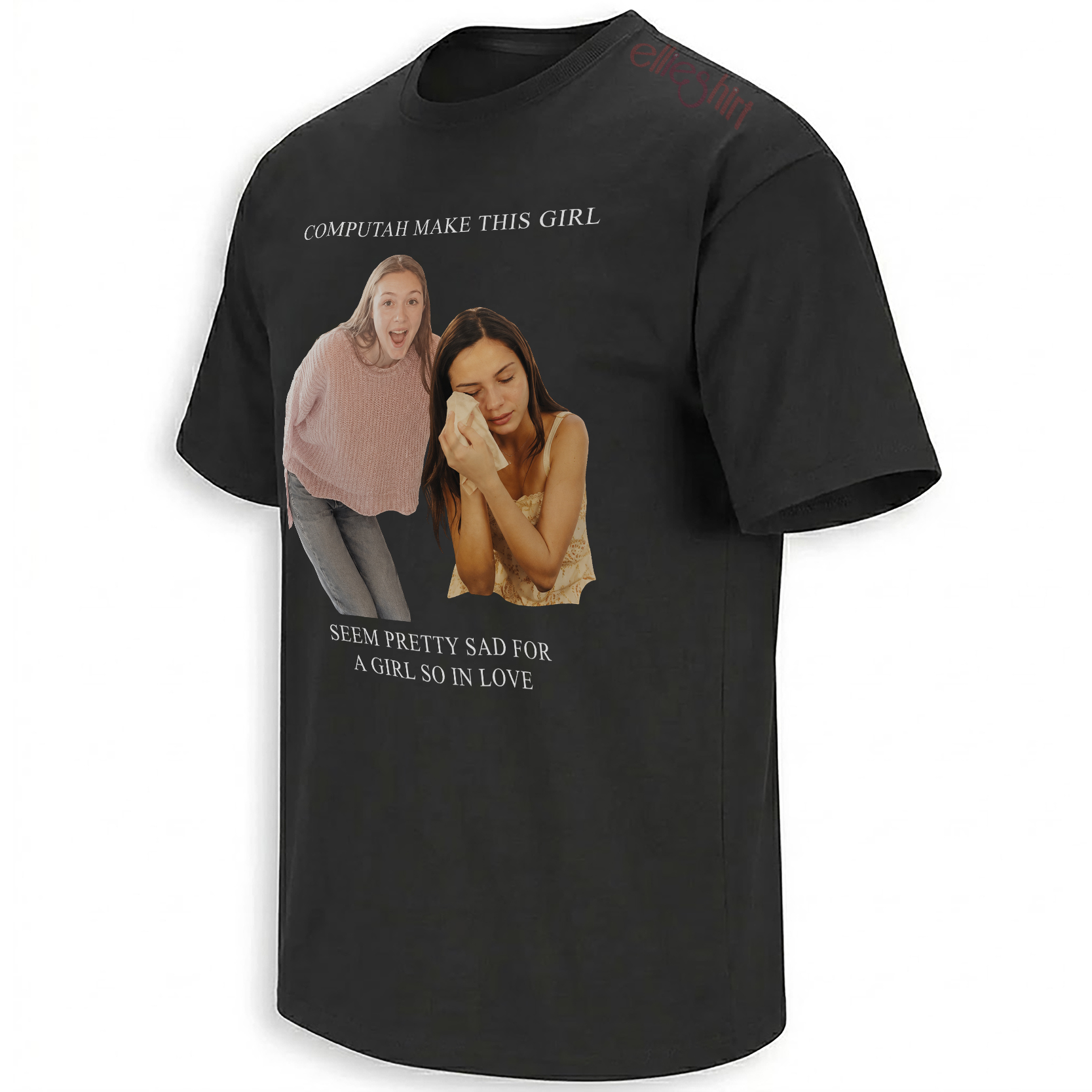
Why the Side-by-Side Portraits Communicate So Quickly
Internet humor rewards immediate contrast. A viewer should understand what changed before reading a detailed explanation. The design accomplishes that through the most basic visual structure available: before and after.
One portrait shows an open smile and social ease. The other displays tears, red eyes and emotional collapse. Their proximity makes the transformation appear instantaneous even though the photographs may belong to completely different contexts.
The phrase above them provides a fictional cause. The sad image does not simply follow the happy one; it is presented as the product of a command. This converts emotional contrast into a miniature narrative.
The viewer reads the design in three quick movements: identify Rodrigo, compare the faces, understand the album-title joke. That efficiency is why the graphic can circulate as both apparel and screenshot. It does not require a long caption to become legible.
- Recognition comes first. Rodrigo’s two portraits establish the celebrity and the emotional contrast immediately.
- The command creates the mechanism. “Computah” imagines technology transforming the cheerful image into a marketable picture of sadness.
- The album title completes the joke. “For a girl so in love” explains why the sadness appears contradictory rather than ordinary.
- Rodrigo wearing the idea makes it self-parody. The artist becomes an active participant in the meme rather than its distant subject.
Pop Stars Now Comment on Their Own Image Construction
Earlier celebrity culture often depended on maintaining distance between the public image and the machinery that produced it. Album photography, styling and press narratives were presented as natural extensions of the artist rather than coordinated creative decisions.
Social media weakened that illusion. Audiences now see behind-the-scenes photography, alternate covers, rejected visuals and jokes made during production. They understand that every era is assembled through fonts, colors, costumes, poses and emotional themes.
Rodrigo’s shirt belongs to that more transparent form of pop performance. It does not expose a scandalous secret. Everyone already knows album images are constructed. The humor comes from pretending the process required almost no thought at all.
This self-awareness strengthens rather than weakens the era. By joking about the visual formula, Rodrigo signals that she understands how fans are reading it. The public image remains designed, but the artist is allowed to stand outside it for a moment and laugh.
Sadness Has Always Been Central to Olivia Rodrigo’s Pop Language
Rodrigo’s music became culturally dominant through emotional directness. Heartbreak, jealousy, embarrassment and anger were not hidden beneath distant metaphor. They were placed at the center of songs and delivered with enough specificity to feel private while remaining broad enough for millions of listeners to recognize themselves.
That history gives the “Computah” joke additional depth. A fictional machine is not creating an emotion foreign to Rodrigo’s work. It is exaggerating a quality audiences already associate with her songwriting.
The important distinction is between sadness as experience and sadness as visual branding. Songs can hold contradictory feelings over several minutes. An album image has to communicate in a second. Tears, dark makeup, altered posture or a distant stare become shorthand for an emotional complexity the music later expands.
The shirt recognizes that reduction. It imagines a computer taking an ordinary image and adding exactly enough visible distress to prepare it for the album era.
The songs explain why the girl is sad. The meme jokes about how quickly an image has to communicate that sadness before anyone presses play.
The New Album Is Built Around Emotional Contradiction
The 13-song album moves between romantic intensity and the emotional damage contained within it. The first part presents the heightened feeling of being “so in love,” while the later material shifts toward the sadness that complicates the phrase.
That structure prevents the title from operating as a simple breakup statement. The girl is not sad because love is entirely absent. She appears sad while love is still part of the picture.
This distinction matters because it reflects a more unstable emotional state than clean heartbreak. Love can be real while also producing fear, imbalance or disappointment. Happiness and sadness do not arrive in separate eras; they can occupy the same relationship and even the same photograph.
The shirt reduces that complexity to two faces, but the reduction is intentional. Its humor depends on the audience already knowing that the emotional reality is more complicated than a before-and-after edit.
The design transforms the record’s central contradiction into visual shorthand. The smiling portrait represents romantic expectation; the crying portrait represents the melancholy that continues beneath it.
Why Fans Respond to Self-Deprecating Celebrity Humor
A celebrity meme becomes more powerful when the subject demonstrates that they understand it. Fans are accustomed to public figures being protected by formal branding, carefully edited captions and promotional language that avoids embarrassment.
Self-deprecating humor interrupts that distance. It shows the artist recognizing the absurdity of celebrity image-making without pretending that the image itself has no importance.
Rodrigo has frequently used visual comedy alongside emotional seriousness. Loud stickers, deliberately awkward styling, teenage notebook aesthetics and exaggerated expressions have allowed sincerity and irony to coexist across her releases.
The “Computah” shirt fits that pattern. The tears remain emotionally recognizable, but the framing prevents the image from becoming solemn. Rodrigo can be the girl who writes sad songs and the person amused by how reliably the public expects sadness from her.
The Typography Makes the Design Feel Like a Bootleg Instruction
The words do not read like polished official album branding. They resemble a caption added quickly to an image, a bootleg concert shirt or an early internet graphic created before anyone worried about perfect alignment.
That visual roughness matters because a clean luxury treatment would weaken the joke. “Computah” should look as unserious as it sounds. The phrase needs the energy of someone pointing at a screen and making an unreasonable request.
The bright yellow shirt color adds another productive contradiction. Sadness is normally packaged in black, grey, dark blue or muted purple. Yellow introduces cheerfulness before the viewer reaches the crying portrait.
As a result, the garment performs the same contradiction as the album title. It looks sunny from a distance and emotionally distressed up close.
A bright, optimistic field makes the tears more surprising and prevents the graphic from becoming visually heavy.
High-contrast wording resembles an instruction typed quickly rather than an elegant album campaign headline.
The emotional difference between the images matters more than photographic consistency, reinforcing the collage-like internet aesthetic.
From Album Cover Analysis to Wearable Reaction Image
Most album merchandise asks the wearer to display allegiance: an artist name, cover image, tour date or song lyric. The Computah Make This Girl Seem Pretty Sad design does something slightly different. It allows the wearer to participate in the conversation surrounding the era.
The graphic is not simply a reproduction of the album cover. It is commentary on how a cover image is read, produced and converted into fan language.
That distinction helps explain why artist-worn graphics travel so quickly online. Fans are not only seeing a product. They are seeing an artist endorse a particular interpretation of their own work.
Within Ellie Shirt’s newest pop-culture graphics , the design functions as a timestamp from the album’s first week—the moment when its emotional title stopped belonging only to the track list and became an adaptable internet joke.
Frequently Asked Questions
What does “Computah Make This Girl Seem Pretty Sad” mean?
The phrase jokingly imagines someone instructing a computer to transform a cheerful Olivia Rodrigo photograph into a sad image matching the title of her third album.
What Olivia Rodrigo album does the meme reference?
It references Rodrigo’s third studio album, You Seem Pretty Sad for a Girl So in Love, released on June 12, 2026.
Why are there two Olivia Rodrigo portraits in the design?
The smiling and crying portraits create a before-and-after structure that turns the album title’s contrast between love and sadness into an immediate visual joke.
Why is “computer” written as “computah”?
The exaggerated spelling makes the command sound intentionally unsophisticated and theatrical, adding the tone of an internet meme rather than a serious editing instruction.
Did Olivia Rodrigo wear the Computah shirt?
Rodrigo shared imagery of herself wearing the phrase during the first week of the album’s release, turning the fan-style joke into self-aware commentary from inside the era.
Why does the yellow shirt color matter?
Yellow creates a cheerful visual field that contrasts with the crying portrait, reproducing the same tension between happiness and sadness found in the album title.
Why did the phrase become popular with fans?
The design combines a recognizable album title, contrasting celebrity images and a simple technology joke that can be understood immediately and shared without additional explanation.
The Computah Make This Girl Seem Pretty Sad graphic preserves the moment Olivia Rodrigo’s third-album title became a self-aware joke about tears, editing and the visual machinery behind a pop era.
Computah Make This Girl Seem Pretty Sad Shirt turns Olivia Rodrigo’s You Seem Pretty Sad for a Girl So in Love album title into a self-aware pop-culture meme. Contrasting happy and tearful portraits create a playful before-and-after joke about emotional branding, image editing and the visual language of her third album era.