Wemby and Brunson Turned One Finals Shove Into Basketball Mythology
Game 3 already had the score, the Garden noise and the Spurs’ first real answer. Then one Wembanyama shove on Jalen Brunson gave the internet something stranger: a Finals controversy that looked like it belonged in a museum.
Some NBA Finals moments become highlights. Some become arguments. A few become paintings before the night is even over.
Victor Wembanyama’s shove on Jalen Brunson in Game 3 lived in all three categories at once. The Spurs beat the Knicks 115-111 at Madison Square Garden, Wembanyama delivered the kind of 32-point performance that re-centered the series, and yet the image people kept returning to was the physical mismatch: the towering alien figure, the smaller Knicks captain, the sudden force, the missed whistle, the outrage.
That is why the Hercules and Nessus framing works. It does not treat the play like a normal basketball collision. It captures how the internet actually saw it: half controversy, half classical sculpture, half meme, even if the math makes no sense. The moment looked too dramatic to stay inside a box score.
The Controversy Was Built For The Internet
The play had every ingredient NBA internet loves: a superstar, a missed call, a size mismatch, a Finals setting, a hostile New York crowd and a disciplinary question hanging over the aftermath. Knicks fans saw Brunson get thrown down. Spurs fans saw Brunson grabbing and fighting through contact first. Neutral viewers saw the kind of officiating debate that turns a single clip into a national argument.
The league’s postgame handling only added fuel. Officials acknowledged that a foul should have been assessed on Wembanyama, but the play was not upgraded to a flagrant. That distinction mattered because Wembanyama already had flagrant points from earlier in the postseason, and any additional upgrade would have changed the stakes around his Finals availability.
So the conversation split immediately. Was it dirty? Was it just playoff physicality? Was Brunson selling contact? Was Wemby getting superstar protection? Those are basketball questions, but online they became visual language. The clip needed a frame big enough for the absurdity.
Why Hercules And Nessus Fits The Wemby-Brunson Image
The original Hercules and Nessus composition is famous because it freezes violence into a dramatic physical arrangement. Bodies twist. Force becomes sculpture. The scene feels mythic because the figures look larger than the moment itself.
That is exactly what the Wemby-Brunson shove became in fan culture. Wembanyama is already described through myth and science fiction: alien, impossible, unreal, too long for normal basketball geometry. Brunson, meanwhile, carries the opposite kind of myth: footwork, toughness, low center of gravity, New York captain energy, the human-sized hero trying to survive giants.
Put them together in a Finals controversy and the classical reference stops feeling random. It becomes a visual joke with real bite. The design says what the timeline was already implying: this was not just a foul debate; it was a mythological mismatch staged inside Madison Square Garden.
The Design Works Because It Treats Discourse Like Art History
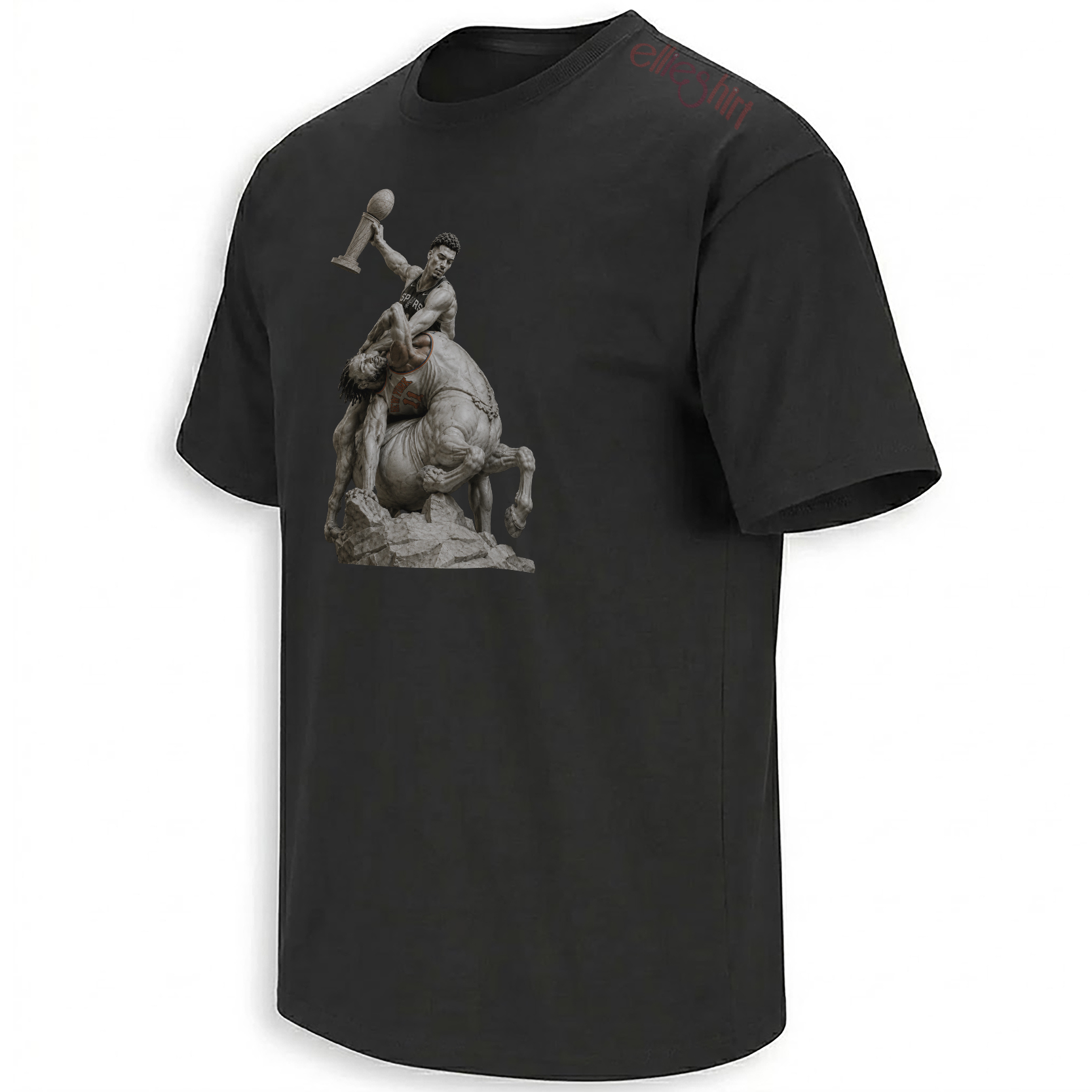
The Wemby Shoves Brunson Shirt Hercules Nessus design does not simply redraw a basketball scuffle. It elevates the absurdity. That is the point. The internet had already turned Wembanyama into a giant myth figure and Brunson into the Garden’s wounded protagonist; the artwork just gives that conversation a classical body.
The statue-like styling matters because it slows the moment down. A shove happens in a second. A sculpture makes it feel eternal. That contrast is what gives the graphic its cultural charge. It turns a missed-call debate into something that looks like it has been sitting in a museum for centuries, waiting for NBA Twitter to discover it.
Visually, the white stone treatment and dramatic body tension make the design feel more like a Finals artifact than a standard player graphic. It carries Spurs fan humor, Knicks anger and the broader absurdity of modern sports discourse in one frozen image.
New York Needed A Villain, And Wemby Gave Them One
Madison Square Garden does not process controversial losses quietly. After Game 3, Wembanyama became more than the Spurs’ franchise star. In New York conversation, he became the figure who spoiled the first home Finals game in decades, benefited from a missed whistle and turned the series into something sharper.
That villain role is part of why the image traveled. Brunson is not just any opponent in this context. He is the Knicks’ emotional center, the player New York fans trust to absorb contact, create advantage and carry the city’s basketball nerve. Seeing him shoved by the tallest figure in the series made the outrage feel personal.
For Spurs fans, of course, the same image reads differently. It becomes proof that Wembanyama is no longer just the future. He is already powerful enough to make the Finals orbit around his body, his decisions and his controversies.
In cultural terms, this design is not a neutral officiating report. It is a visual timestamp of the night the Spurs-Knicks Finals turned mythological — when Wemby’s alien scale, Brunson’s New York toughness and a missed call became one of the series’ defining internet images.
The Finals Archive Needed A Controversy Piece
Every Finals run creates its own gallery. Some images are heroic. Some are joyful. Some are furious. This one belongs to the controversy wall. Inside the broader San Antonio Spurs collection, the graphic captures the moment Wembanyama stopped being merely admired and became feared, argued about and mythologized.
It also belongs beside the wider NBA Finals collection and New York Knicks collection, because the image only works through both fan bases. Spurs fans see power and survival. Knicks fans see a missed call and a villain. The internet sees a museum piece with a box score attached.
That is why the Hercules and Nessus concept has staying power. It does not try to settle the argument. It preserves the argument in the most dramatic possible form.
FAQ
Why did the Wemby-Brunson shove become such a big NBA Finals moment?
It became big because it combined a missed call, a superstar player, Madison Square Garden, Jalen Brunson’s Knicks identity and Wembanyama’s physical scale. The play became both an officiating debate and a viral visual.
Why does the Hercules and Nessus reference fit this design?
The reference fits because the original composition is built around dramatic physical force. Applying that visual language to Wembanyama and Brunson turns a Finals shove into a mythological sports image.
Was Wembanyama’s shove upgraded to a flagrant foul?
No. The league acknowledged that a foul should have been called during the game, but the play was not upgraded to a flagrant foul after review.
Why did Knicks fans react so strongly?
Knicks fans reacted strongly because Brunson is the emotional center of the team, the game was at Madison Square Garden, and the missed whistle came during a Finals loss that ended New York’s long playoff winning streak.
Why does this design feel like a Finals artifact?
It feels like a Finals artifact because it freezes one of the series’ most argued-over images in a classical style. The design preserves the controversy, the meme energy and the Wemby-Brunson matchup in one visual memory.
For fans saving the Finals through its strangest and most argued-over images, the Wemby Shoves Brunson Hercules and Nessus shirt sits naturally inside the series — not as a final verdict on the play, but as the museum version of the controversy everyone kept replaying.